
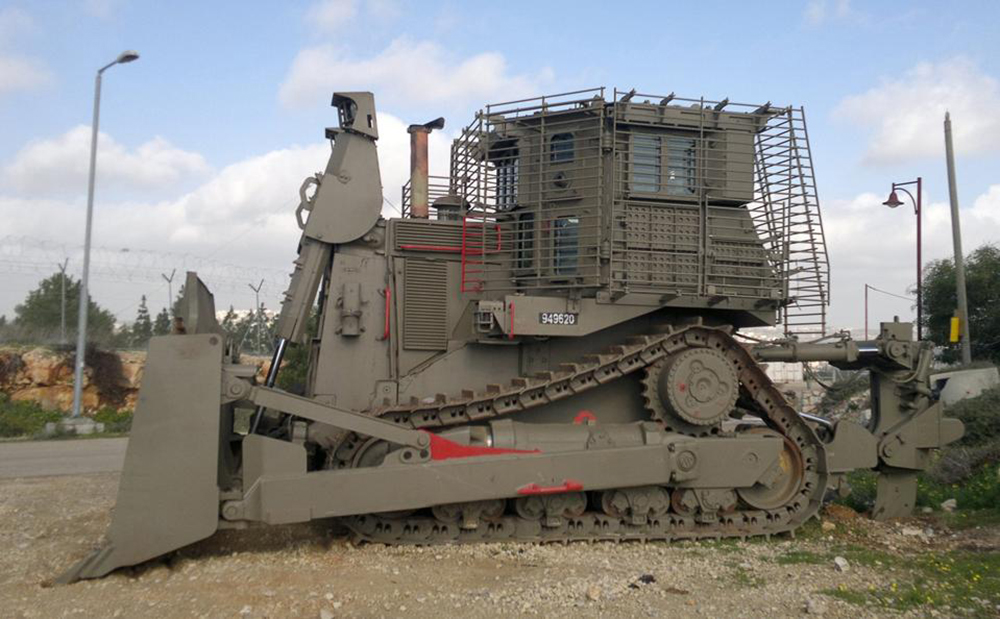
Armored Caterpillar D9 bulldozers are notorious as the Israeli military uses them to clear ground on the Gaza Strip and West Bank.
FORBES.COM
Peoria is lately deluged with Caterpillar PR media, the likes of which have rarely been seen in these parts. That’s saying something, especially in the hometown overseeing nearly a century of incredible growth prior to the Fortune 100 company’s braintrust abandoning central Illinois for reasons still unclear but possibly connected to tax avoidance.
The daily newspaper here has just published a series of fawning articles with no real recognition of the entire story of the Caterpillar century, namely the debilitating labor conflicts of recent decades. References to Caterpillar anti- union campaigns has been so far minimized, company actions that shattered families, drove down wages and benefits across the region, and cast a deadening pall across the city instigated by company overlords more than happy to bulldoze union labor.
Not to mention the decades of sales and support and ongoing profits made from a long-term business relationship with apartheid Tel Aviv. It’s a relationship described, among others, in the just-issued June 30, 2025, United Nations report titled “From economy of occupation to economy of genocide” as:
 “Providing Israel with equipment used to demolish Palestinian homes and infrastructure, through both the U.S. Foreign Military Financing programme and an exclusive licensee requisitioned by Israeli law into the military. In partnership with (other companies), Israel has evolved Caterpillar’s D9 bulldozer into automated, remote-commanded core weaponry of the Israeli military, deployed in almost every military activity since 2000, clearing incursion lines, ‘neutralizing’ the territory and killing Palestinians.”
It’s a genocide profit center that only really came across the American public’s radar the past 18 months or so. According to the UN report:
“Since October 2023, Caterpillar equipment has been documented in use carrying out mass demolitions — including of homes, mosques and life-sustaining infrastructure — raid hospitals and crushing Palestinians to death.”
Somehow, most of that news has not been covered by Peoria-based corporate media. Not even the newest contract between Israel and Caterpillar approved by the United States earlier this year for additional D9 bulldozers and related equipment for military purposes for an estimated $295 million.
While Peorians can read about the Joel Feucht families doing well by Caterpillar www.pjstar.com/story/news/local the Peoria Journal Star has produced barely any coverage of numerous local Palestine rallies and marches and special events reaching back to 2021, where Caterpillar complicity in the internationally recognized genocide in Palestine inevitably gets raised.
Yeah, that might be just a little awkward.
Union numbers collapse
None of this should come as a great surprise to anyone who has lived in and around Peoria for more than a few minutes. Caterpillar arguably went to war against its own union employees long before making profits off the occupation and genocide in Palestine.
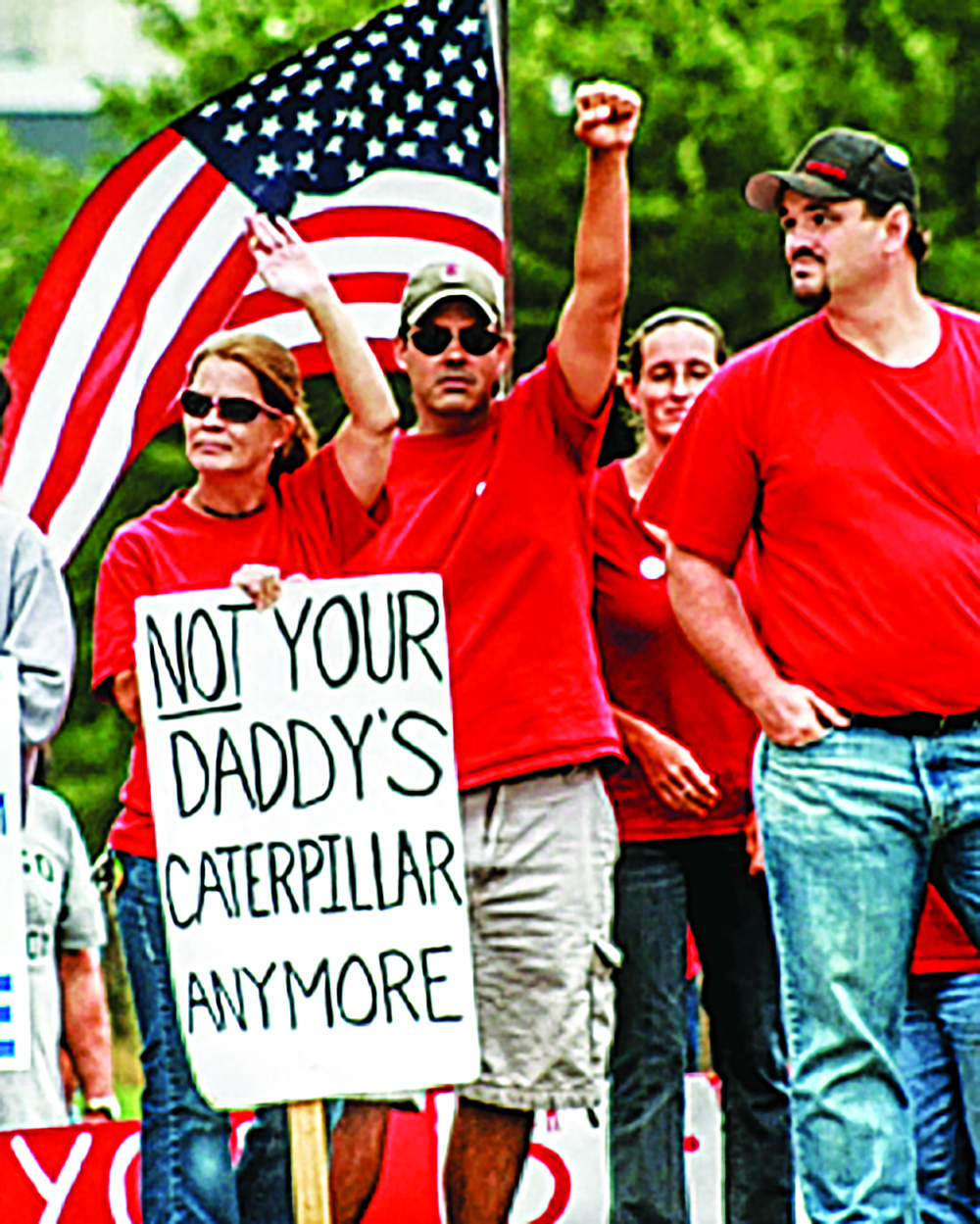
Labor strife with the local Fortune 100 company has been catastrophic to central Illinois.
(Fox Valley Labor News photo)
Starting in the early 1980s, Caterpillar forced long strikes with union workers in the Age of Reagan’s prolonged attacks on organized labor. It didn’t help that United Auto Workers leadership locally and nationwide repeatedly caved to Cat management demands. From a UAW membership of nearly 50,000 in 1979 at Caterpillar, total UAW membership at Cat now stands at only 7,000, according to published reports in 2023.
Working families formerly employed by Cat and related suppliers started leaving central Illinois in droves in the ’80s, for Texas and anywhere else they thought might have jobs. Any jobs. This trend helped hollow out the once-thriving retail heart of downtown Peoria. Families turned on one another as people crossed picket lines while others who remained steadfast vowed never to forgive those who performed this previously unthinkable sellout.
Things just got worse.
“Of particular significance were the experiences of the 1990s, when the UAW shut down powerful strikes by Caterpillar workers in 1992 and again in 1995. These were abject capitulations without precedence in the history of the union. The impact of these betrayals is still deeply felt today,” writes journalist Shannon Jones in Class struggle at Caterpillar: Lessons from the Past.
Caterpillar would rush to hire permanent striker replacements just as quickly as possible as leverage against the union.
Caterpillar eventually broke the UAW in Peoria. “Caterpillar hates unions more than it loves profits,” one UAW official explained in 2008. A decade later, Caterpillar nearly broke Peoria when its top brass took company headquarters, like a thief in the night, to places far beyond central Illinois.
Since we’re talking about the firm’s century, let’s briefly recall how Caterpillar made its way through the Depression in the 1930s, absolutely focused on sales to banks, financiers and absentee land owners. Of course, this came at the expense of “tractored out” share croppers, harvest workers, and bankrupted farmers.
So much so that the trend toward exploiting monied establishment and Cat machinery as a symbol for our lost humanity, no less, was noted in the defining book of the time, The Grapes of Wrath by John Steinbeck:
“A twitch at the controls could swerve the cat’, but the driver’s hands could not twitch because the monster that built the tractor, the monster that sent the tractor out, had somehow got into the driver’s hands, into his brain and muscle, had goggled him and muzzled him — goggled his mind, muzzled his speech, goggled his perception, muzzled his protest.”
Talk about symbolism.
Racist from the start
From its start and through the Depression years, so few Black workers were allowed to work at Caterpillar. It was only the onset of WWII and the demands of a wartime economy that finally changed things, but not by much.
During Black History Month 2023, Caterpillar came out with a number of Black employee profiles and touted the fact that “Black employees began working at Caterpillar more than 80 years ago.”
True, but full context was not given:
“Caterpillar Tractor, where virtually the only jobs open to Blacks were janitorial. We wanted the opportunity to do more than sweep floors,” recalled the late C.T. Vivian in his memoir co-written with Steve Fiffer It’s in the Action: Memories of a Nonviolent Warrior.
“Newly enacted laws said we were entitled to such opportunities, but the company argued that we were unfit for jobs requiring greater responsibilities. Caterpillar’s president kept saying that Blacks could not be hired for more skilled positions because they didn’t come to work on time.”
Reprehensibly, this was the situation at Caterpillar during and after WWII.
Vivian and others intervened by demonstrating how Black workers not only arrived on time but worked hard and stayed after hours. “More than that, they were proving that the arguments used to hold back them and their brothers and sisters were hollow. They forced the company’s hand. Soon they had the opportunity to apply for and fill those positions for which they were eminently qualified.”
Vivian became one of the nation’s leading and most renowned civil rights leaders, described as a “field marshal” for the Rev. Dr. Martin Luther King Jr. and he was a recipient of the 2013 Presidential Medal of Freedom, the nation’s highest civilian award.
Vivian began his professional career in Peoria as assistant boys director at the George Washington Carver Community Center. He then helped to open up the still-segregated postwar restaurants and recreation facilities in Peoria, while teaming up with the militant United Farm Equipment Workers, the precursor union here to the UAW, regarding employee discrimination at Caterpillar.
But Caterpillar’s discriminatory practices toward the Black community definitely were not resolved in the late 1940s.
As late as the 1960s, John Gwynn, President of Peoria’s NAACP chapter from 1961 to 1993, mounted local campaigns against segregation in housing, schools, government, restaurants, and corporations like Caterpillar and Central Illinois Light Company, according to the Peoria Journal Star
And as recently as last year, Caterpillar was ordered to pay $800,000 to resolve racial hiring discrimination at its facility in Decatur, according to the U.S. Department of Labor, which entered into a conciliation agreement with Caterpillar Inc. to resolve alleged systemic hiring discrimination against 60 Black applicants dating back to 2018. Caterpillar is paying that $800,000 in back wages and interest to affected job applicants and offering jobs to 34 eligible class members.
Some investors flee
Back to its more worldwide concerns, Caterpillar has been targeted by the international Boycott Divestment Sanctions (BDS) nonviolent economic movement for two decades. Not only does Caterpillar knowingly sell its bulldozers for use by the Israeli military for illegal home demolitions and military operations, but it also sells its equipment to Israel for construction of illegal settler facilities on stolen Palestinian land.
Presbyterian Church USA, Quaker Friends Fiduciary Corporation and The United Church of Christ have all divested from Caterpillar. The company has been removed from several MSCI Environmental, Social and Governance indices. TIAA-CREF removed Caterpillar from its socially responsible investment portfolio and sold its Caterpillar shares.
 No less than the late Archbishop Desmond Tutu said in 2018, “In this inhumane environment of suffering and oppression, the Church finds itself invested in corporations long known to be providing products and services to those responsible for the occupation. This year the Episcopal Church sponsored shareholder resolutions to hold two of those corporations accountable: Caterpillar and Motorola Solutions.”
Last year, Norway’s largest private pension fund announced it was divesting $69 million from Caterpillar.
Shockwaves from the devastating UN report authored by Special Rapporteur Francesca Albanese on the genocide in Gaza are reverberating worldwide, with serious amplification from the just wrapped two-day Hague Group summit in Bogota.
Specifically calling out the executives of the 60-plus corporations named in the UN report as deeply complicit in the Israeli occupation and literal genocide of Gaza has really rattled cages in Washington, D.C., including the glass and paneled boardrooms of the Fortune 100.
CEOs at Caterpillar like Donald Fites, Doug Oberhelman, Jim Umpleby and now Joseph Creed might soon be looking over their shoulders.
At the very least, they just might have to forget about any more trips abroad.
— Lawrence J. Maushard is an author and journalist who has worked in occupied Palestine, and a founding member of Peoria For Palestine. The Peoria-based writer was born & raised in the city’s Center Bluff district. He is a graduate of the English Department at Illinois State University. More of his work at www.maushard.com