
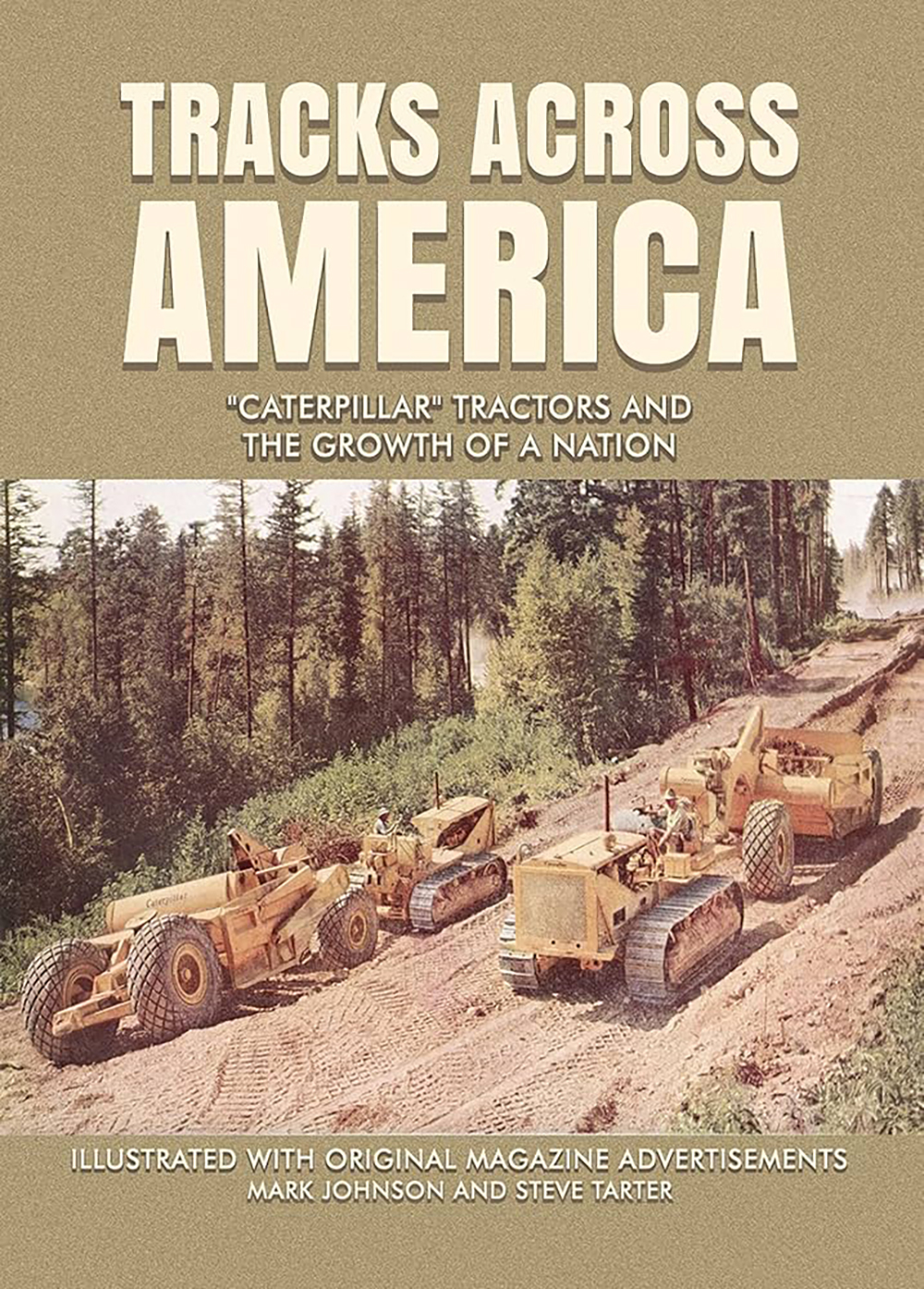
In 1925, Holt Mfg. and C.L. Best Tractor Co. merged to form Caterpillar Tractor Co., and 100 years later a new book helps to commemorate that centennial. “Tracks Across America: ‘Caterpillar’ Tractors and The Growth of A Nation” was co-authored by Mark Johnson and Steve Tarter, both veterans of decades in Peoria (Johnson at Cat and Tarter at the Journal Star.) With a Foreword by former Congressman and Transportation Secretary Ray LaHood, the 268-page Dorrance hardback is a history illustrated with 142 magazine ads, many in color, available at select retailers and online. This excerpt offers a glimpse of how Cat and its workers made history.
 World War II is one of those subjects that never fails to draw our attention. While books, TV programs and movies continue to chronicle battles in Europe or the Pacific, there also was fierce fighting elsewhere: the often-overlooked China-Burma-India (C-B-I) theater of operations.
While “only” 250,000 Americans served in the C-B-I theater (just 2% of the 12.3 million U.S. troops that served during the height of the war), the region was important in Allied efforts to defeat the Japanese who, early in the war, controlled much of Asia.
It was vital to Allies to support China. However, the Chinese army was in desperate need of supplies since Japan’s 1942 invasion of neighboring Burma (now Myanmar). The Japanese controlled the Burma Road, the single supply route to China by land.
Allied efforts to airdrop supplies to the Chinese army were likely to be insufficient, so the decision was made to circumvent a portion of the Burma Road and open a new route to supply China.
Rough route
That new route was given the name Ledo Road. Constructing this new road is considered to be the toughest job ever given to U.S. Army Engineers in wartime. The 465-mile route ran from Ledo, India, to a junction on the old Burma Road at Shingbwiyang, Burma.
The road cut through dense jungle and across towering mountains. It crossed fast-flowing rivers and treacherous swamps. Workers had to contend with malaria, dysentery, clouds of mosquitoes and leeches, not to mention Japanese snipers. Temperatures could reach 115 degrees. Rain during the monsoon season (sometimes 50 inches of rain in a month) could turn a dirt road into a sea of mud.
In addition to building the Ledo Road, engineers and workers also upgraded over 600 miles of the Burma Road. More than 1,100 Americans died in the building of this 1,100-mile stretch, giving it one of its nicknames, the “Man-a-Mile” Road. For each American soldier who died (one for each of the 1,100 miles of the road), 14 more soldiers would be evacuated sick from malaria, dysentery, cholera, infections and jungle rot.
It took two-and-a-half years to complete the project with a round-the-clock schedule manned by 15,000 Americans, over 60% of them African Americans. The workforce included 35,000 Indian, Burmese and Chinese workers. In the months between the opening of the Ledo Road and the Japanese surrender, some 129,000 tons of supplies, 26,000 vehicles, 6,500 trailers, and more than 6 million gallons of fuel were transported from India to China.
“To appreciate the immensity of the task, it is necessary to realize that every piece of equipment on this road was brought more than 1,500 miles by sea and rail before going to work,” noted A.T. “Arch” Steele, a Chicago Daily News correspondent. “In little more than a year this mass of machines has cut a passable road through well over 100 miles of unbroken forest, across five mountain ridges to link the plains of India with the plains of Burma.”
Precious Cats
The road project called for a special effort. The U.S. Army recognized that the primary piece of earthmoving equipment used for the project would be “Caterpillar” bulldozers. And keeping those machines operating in this harsh environment was a challenge of tremendous proportions.
The U.S. Army knew exactly who they needed to meet this challenge. So in July 1942, the request was made to Caterpillar Tractor Co. in Peoria. Would the company support the formation of a unit of company employees who were experienced in the design and maintenance of “Caterpillar” tractors? Caterpillar Vice President D. A. Robison assured the Army that the company would cooperate in any way possible.
The Army Corps of Engineers organized the 497th Engineer Heavy Shop Co., the first unit in U.S. history organized by a manufacturing company and manned primarily by its own employees.
That September, 191 men — 158 Caterpillar employees and 33 other men from the Peoria area, including blacksmiths, carpenters, electricians, machinists, mechanics and welders, were sworn in at the recruiting office on Main Street in Peoria.
River City sendoff
Activation occurred on October 1 in Peoria at an impressive ceremony with several speeches including one by Lewis B. Neumiller, President of Caterpillar Tractor Co. The Caterpillar band led the entire group from the courthouse in a parade down to the train station. A train left at 2 that afternoon carrying the unit to Scott Field, near St. Louis. From Scott Field, the men were sent to Camp Claiborne in central Louisiana for four weeks of basic training. They also received special training in heavy shop work. By the end of November, the company received notice that they should prepare for transportation overseas.
Once they arrived in India, although the 497th was not a combat unit, the war was never far away. Gunfire and fighting could sometimes be heard along with frequent dogfights over their camps as American pilots flew over “the Hump” (the Himalayas) into China.
The Army’s record of the construction effort in the China-Burma-India theater described the 497th: “Its primary function was to repair and rebuild the heavy machinery used by the engineers. The men of this organization displayed remarkable ingenuity in carrying out their duties. Since no concrete was available, they set their heavy precision machine tools on wood beams, a method never attempted back home.
“Having no foundry and being without metal stock, the men build up worn parts by welding, then turned down the parts to standard size on machine tools. In less than three months, the salvage section of this unit had retrieved 14,000 parts secured from ‘cats,’ graders, tractors, and tanks which had been wrecked or junked along the road.”
Completing the Ledo Road did more than allow supplies and troops to travel freely into China. Lewis Pick oversaw the project, and Wayne Whittaker in Popular Mechanics wrote, “General Pick’s men had to build not only the main Ledo trace but dozens of combat roads leading off into the jungle to clean pockets of the enemy. They cut roads to battlefields, … they built airstrips and paved the way for Brigadier General Frank Merrill’s famed Marauders.”
Road that couldn’t be built
The Ledo Road was supposedly the road that couldn’t be built, Pick said at his first staff meeting in Ledo. “Too much mud, too much rain, too much disease. From now on we’re forgetting this defeatist spirit. The Ledo Road is going to be built, mud and rain and disease be damned!”
Also, the fact that 60% of the Ledo Road builders were African Americans led to change, said Geraldine Seay, a retired Florida A&M University faculty member whose article on the road was titled “Highway to Freedom.” “Their contributions would directly affect integration efforts confronted by the United States in the decades following the war (e.g., President Truman’s 1948 order to end racial segregation in the U.S. military).
“The Ledo Road experience not only helped change U.S. attitudes toward African Americans, but it transformed Black people,” she continued. “The extraordinary success of blacks as front-line workers in the unprecedented engineering and construction feat represented by the completion of the Ledo/Stilwell Road rejected the myth of Black inferiority.”
Despite the effort’s challenges and the road now reclaimed by the jungle in many places, it will be long remembered. Amid the devastation created by war, whenever possible, extraordinary accomplishments also receive focus. The Ledo Road is one of those accomplishments. The efforts of the men and women of the U.S. Army did more than build a road in wartime, they secured a place in history.
Go online to tracksacrossamerica.com