
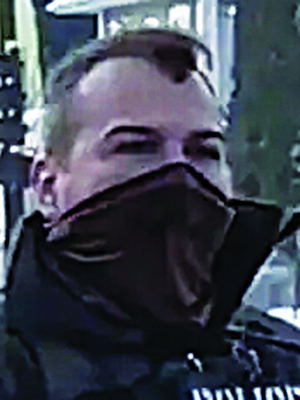
JONATHAN ROSS
I have only a vague memory of Jonathan Ross, the ICE agent who shot and killed Renee Good in Minneapolis after days of conversations with my high school classmates plumbing the depths of scenes from my teenage years. Ross went to Richwoods with me and grew up in my neighborhood in Peoria.
The memory is almost nothing: He was in his garage while I spoke to his younger brother, near Ross’ blue Pontiac Fiero in the driveway.
I am far from alone now in looking for clues in my memory bank about Ross that might provide insight into how he ended up being a soldier in President Donald Trump’s immigration army — and why he reacted so violently to Good’s relatively innocuous actions. Many of my classmates at Richwoods High School have been asking themselves the same questions since I asked them whether anyone remembers Ross. All of us are now engaged in the peculiarly American task of trying to find a reason in our memories why one of our neighbors, classmates, friends or loved ones has committed an act of heinous violence.
Right and wrong
The federal government is not just refusing to investigate Good’s killing — standard practice across the nation for all police killings — but is demanding that Ross be hailed a hero. And according to Homeland Security Secretary Kristi Noem, even an anonymous one.
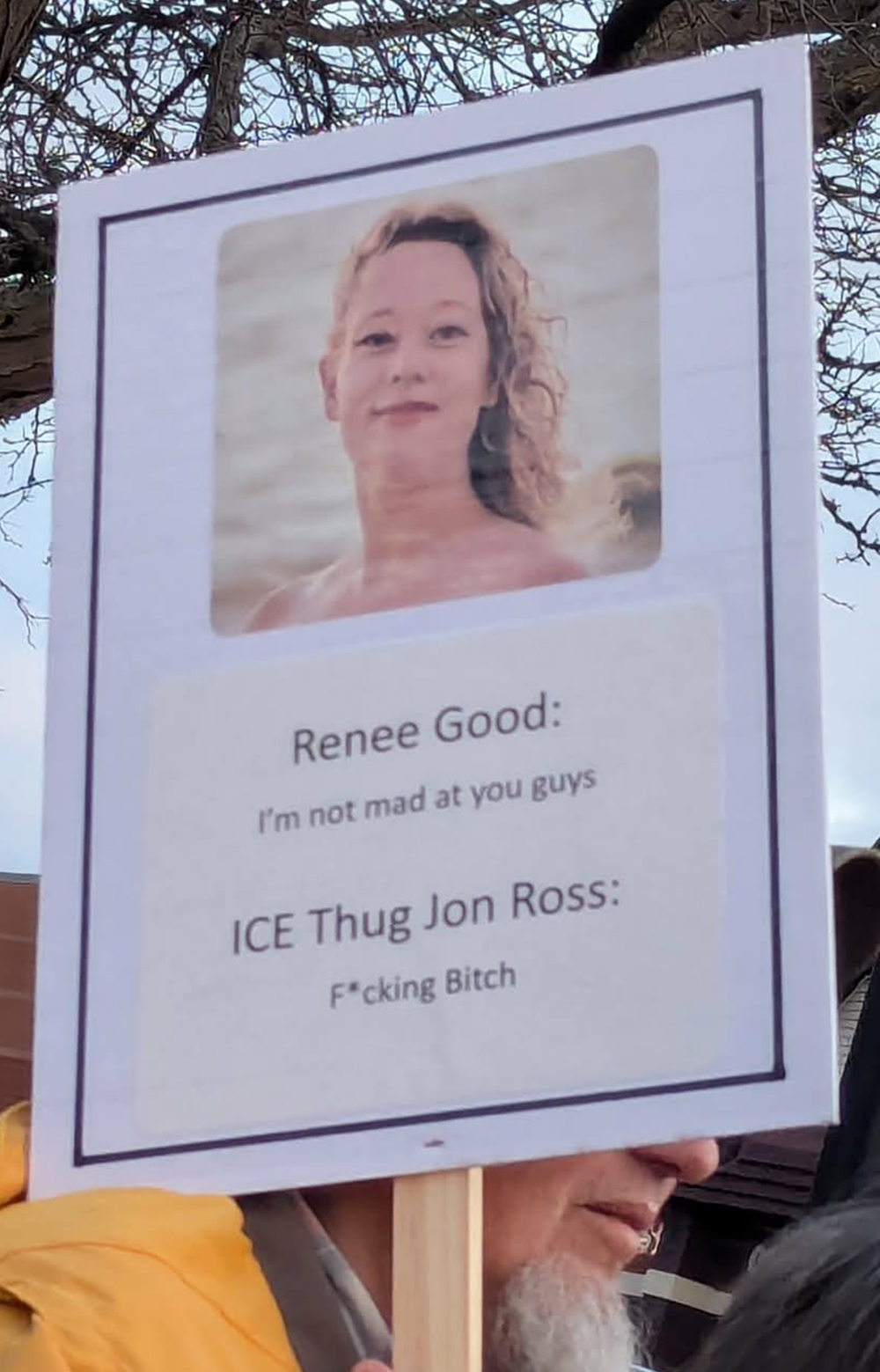
Several signs with the late Renee Good were held up by participants in the candlelight vigil held for the 37-year-old who was killed in Minneapolis by ICE agent Jon Ross, at Main and University. KANDAS MERRIAM
“Don’t say his name,” Noem said on CBS News Sunday. “For heaven’s sake, we shouldn’t have people continue to dox law enforcement.”
But it was Noem’s own comments about Ross’ history — being dragged by a vehicle last year during an immigration operation — that exposed my fellow Richwoods alum. The sentiment behind Noem’s whining demand is that the American public should not be allowed to know the identity of a federal agent who shot and killed a U.S. citizen.
Having masked, anonymous agents of the federal government kill people with impunity is the stuff of authoritarian regimes throughout history. In the case of Ross, a “don’t tread on me” Trump supporter of the American right and one of Noem’s lawless immigration agents, one of those openly authoritarian Americans grew up right down the street from me.
How can people who grew up in the same peaceful neighborhood and went to the same school in the same Midwest town come to completely different conclusions about America?
History of violence
Over and over again since the Columbine (Colo.) High School shooting in 1998 — when Ross was a sophomore and I was a freshman in Peoria — Americans have tried, often in vain, to retroactively find the warning signs that could have prevented the violence that’s become a routine part of life.
This time, the possible silence of America’s latest high-profile killer will be helpfully aided by the full force of the U.S. government, which is not investigating Ross’ actions that day, but instead the actions of Good.
Soon enough, Ross will be back on the streets to carry out his duties — possibly resulting in more unnecessary violence that comes with the explicit support of as much as the third of the country that voted for Trump. Ross will be a fascist killer let loose as both an example of what Trump and many of his supporters would like to see happen to any American who stands as a threat to them.
Good was married to a woman with a child from a previous marriage. She used pronouns and was a poet. The American right can now feel good about her death because she represents what is wrong.
Ross, meanwhile, was a veteran of immigration enforcement who, at his home in Minnesota, flew pro-Trump and the Gadsden flags. “Don’t tread on me” is ironic considering Ross’ work for a federal agency that routinely does the treading — so exactly the person who the left decries, and the right lionizes.
History will not hide its judgment.
‘Conservative Christian’
Ross was a year ahead of me at Richwoods High School. His younger brother, Ben, was in my Class of 2002.
The brothers lived with their father, Ed, in a home at the corner of a cul de sac just down the street from my childhood home in a mostly white suburban neighborhood on the far north side of Peoria. Ed told the Daily Mail that his son is a good person, and that he was justified in Good’s killing.
“She hit him,” Ed Ross said. “He also had an officer whose arm was in the car. He will not be charged with anything.”
Not surprisingly, Ed Ross described his son as a “conservative Christian.”
“You would never find a nicer, kinder person,’ Ed Ross said. “He’s a committed, conservative Christian, a tremendous father, a tremendous husband. I couldn’t be more proud of him.”
In high school, Ross was friends with a group of guys who were into cars. At one point, Ross wrecked his Fiero into a telephone pole, a classmate recalled. Another classmate said Ross was in the ROTC at Richwoods. Ross joined the Indiana National Guard, and served briefly in Iraq before joining the Border Patrol in El Paso, Texas.
Arrest record
In 2015, Ross joined Immigration and Customs Enforcement and moved to Bloomington, Minn. There, in June, Ross was injured during an interaction with an undocumented immigrant named Roberto Munoz-Guatemala, who was targeted for deportation. The plan had been to simply interview Munoz-Guatemala, who had previously pleaded guilty for sexual assault of a minor. But instead, Ross broke out a window in Munoz-Guatemala’s car. At trial, an FBI agent on scene that day testified that Ross “had seen something that made him very uncomfortable and I wanted to be in a good position to support him.”
Munoz-Guatemala fled, dragging Ross, whose arm was inside the vehicle. Ross suffered injuries requiring 37 stitches.
Despite that experience, Ross placed himself in front of Good’s SUV as he filmed her with his phone — typically against protocol considering the danger presented by standing in front of a running vehicle. When Good attempted to drive away, Ross was pushed by the front bumper of her SUV. As he slid off to the side, he fired one shot through the windshield, then two more as the vehicle continued to turn away, with Ross’ body clear of any danger.
The Trump administration and right-wing media have claimed Good was purposefully trying to harm Ross. The president himself said that Good “ran over” Ross, despite multiple videos showing that he was not even knocked to the ground. Before the attack, other immigration agents on the scene passed around Good’s vehicle as the “domestic terrorist” waved them through.
The Justice Department is manhandling the investigation, and appears to have no plans to evaluate Ross’ actions at all.
Top DOJ staff have resigned in protest.
Memories
I recalled the vague memory of Ross in my neighborhood: How did he end up as one of the Americans who advocate for this faux-nationalist authoritarianism that is rampaging the country?
Most of the people I spoke to didn’t know Ross at all. Just one remembered any interaction with him. He was at a party and he “creeped” her out, she said. He was “a watcher.” Another classmate described Ross as “quite reserved, oddly unreadable.”
I asked my classmates if anyone would object to me writing that what I saw on the videos of Good’s killing was enough to judge Ross as a member of Trump’s fascist movement to carry out violence against anyone who disagrees with them. No one objected.
— Justin Glawe is an independent journalist based in Savannah, Georgia. He writes the newsletter, American Doom. He is the author of the forthcoming memoir, “If I am Coming to Your Town, Something Terrible Has Happened: the Life and Times of a Domestic War Correspondent.”