
Gentlemen, start your tractors. Neighbors, hold your breath.
In farm country, some proud producers say, “We feed the world,” but though Illinois is the second-largest, corn-producing state, 98% of corn grown in Illinois is field corn used for industrial purposes — not consumption by humans.
Of that, 30% of Illinois corn is used for ethanol production, according to the Farm Bureau, and somewhere between 7% and 15% is used for animal feed or industrial food products such as sweeteners and syrup. Further, about half is exported (depending on shipping disruptions or tariffs and other market factors).
Regardless of crops’ end-use purposes, agribusiness for decades has increasingly relied on pesticides and fertilizers, and the United States saw higher yields of commodity crops thanks at least in part to agrichemicals sprayed from airplanes, drones, tractors and handheld devices.
“[But] these chemicals can drift through the air or run off into nearby rivers and streams,” said Ben Felder of Investigate Midwest. “And for decades, some farmers and pesticide users have developed neurological and respiratory issues. Thousands of lawsuits have alleged that pesticides and the companies that make them were to blame.”
Hitting home
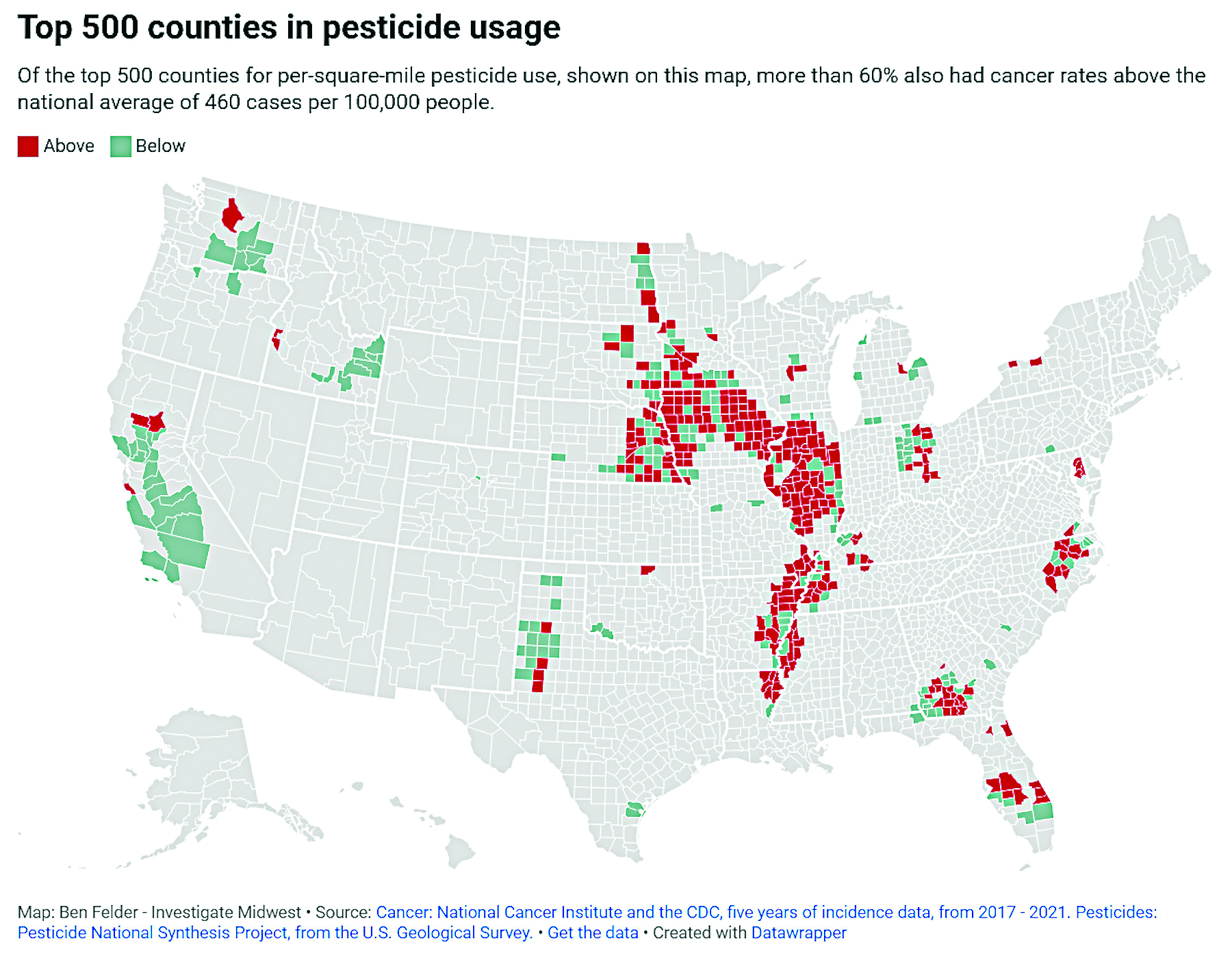
The Tri-County area (with 989 farms in Peoria County, 869 in Tazewell, and 997 in Woodford, according to the USDA Census of Agriculture) has a pesticide use rate about eight times the national average of 197.3 kilograms (435 pounds) per square mile, and a cancer rate about 10% higher than what the National Cancer Institute says is the national rate: 453 cases per 100,000 people (See box).
“Illinois’ industrial agriculture system is responsible for toxic pesticide exposure across communities adjacent to farmland, like here in the central part of the state, where winds carry these carcinogenic chemicals across our parks and playgrounds, exposing children and families with no notice,” Illinois Environmental Council’s Conservation and Sustainable Agriculture Program Officer Lindsay Keeney told The Com-
munity Word. “Pesticide applicators are not required to notify schools before spraying, but we’re working to change that.”
Correlation isn’t cause, but connections cause concerns.
“Cancer is a complex disease and can be caused by numerous environmental and genetic factors,” Felder said. “Some links have been clear — such as smoking and lung cancer — while other forms can be impossible to trace back to an original cause. But scientific research linking pesticides with certain types of cancers has been growing.”
One study — “Comprehensive assessment of pesticide use patterns and increased cancer risk” in the journal Frontiers in Cancer Control and Society — reported that “the impact of pesticide use on cancer incidence may rival that of smoking,” wrote the scientists, who linked pesticides to prostate, lung, pancreas and colon cancers, plus associated pesticides with lymphoma and Parkinson’s disease.
Also, cancer development can range from months to decades. But displaying cancer rates on a map of the nation’s top crop and vegetable growing regions, where pesticide use is highest, is revealing. Illinois, Iowa, Missouri and Nebraska — leading corn-growing states — have the country’s highest cancer rates
Call to action
In Iowa, the legislature seemed to recognize the connection, but last year responded by proposing a law protecting pesticide manufacturers from some lawsuits, not residents. Iowa’s state Senate passed the bill (Senate File 2412) one year ago, 30-19. But ahead of a vote in the House, lobbying by farmer, public health and environmental groups made a difference.
“I call myself a Republican, but this is not about politics,” commented Bill Billings, a resident of Red Oak, Iowa, who was diagnosed with cancer in 2024. “This is about money, about the almighty dollar,”
Iowa’s legislative session ended without the House taking up a vote, although he bill could return in 2026,
In Illinois, lawmakers are trying to prioritize public health.
“House Bill 1596 would require certified pesticide applicators to provide written notice before spraying to private and public schools, daycares and public parks and playgrounds near the application site,” Keeney said. “The notification requirement would apply only to large-scale operations that use boom sprayers, tractor-mounted sprayers, and airplanes to apply weed killers — not residential applications.
“Large applicators should have a real responsibility not to expose their neighbors to dangerous chemicals without their knowledge,” she added. “Our partners at Prairie Rivers Network have called this “chemical trespass,” and they’re right. It’s not safe. It’s not okay. And it is time for the Illinois General Assembly to step up and put in place real protections for central and southern Illinois communities, children, and ecosystems. Sponsored by eight lawmakers, all Democrats, HB1596 was introduced in January 2025. The bill passed the Energy & Environment Committee on March 15, 2025, underwent amendments and was sent to the Rules Committee, which approved it for consideration on Feb. 11 this year and got a second reading two days later. There’s been no action since March 6.
Source material
Nationally, both progressive environmental groups and conservative health movements have called for reducing or eliminating the use of pesticides.
“Health and Human Services Secretary Robert F. Kennedy Jr., a longtime critic of pesticides, in a May 2025 report from his Make America Healthy Again commission, linked pesticide overuse to children’s health issues, which drew praise from both political camps,” Felder said. However, “three months later, Kennedy’s MAHA commission published its final report, which contained no calls to further regulate pesticides. In fact, it called for the federal government to work with large agrichemical companies to ensure public “awareness and confidence” in the EPA’s current pesticide regulations.”
For more on “Pesticide use and cancer risk rise together across America’s heartland”
Investigate Midwest analyzed data across the country, interviewed more than 100 farmers, envi-
ronmentalists, lawmakers and scientists as part of partnership with the Pulitzer Center’s StoryReach
U.S. Fellowship and supported by the Fund for Investigative Journalism. For the original, complete piece go online to investigatemidwest.org