
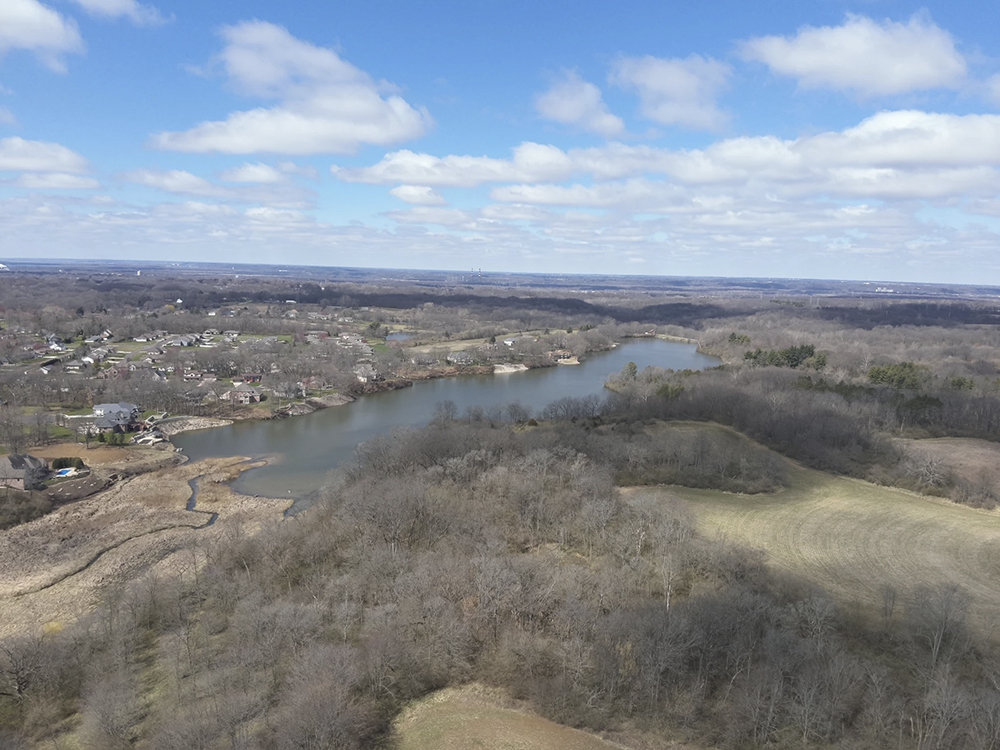
Tazewell County Board members were told Wednesday that Pekin has the sole authority to make decisions about a proposed data center on the 1,000-acre city-owned Lutticken Farm property.
PHOTO COURTESY CITY OF PEKIN
Public debate about a data center proposed on property the City of Pekin acquired last year will continue online and in person, as the City has scheduled a town hall meeting March 24 at Pekin Community High School to discuss the proposed project.
The Tazewell County Data Center Opposition group, which has a Facebook group with more than 2,200 members, previously delivered to the City a petition with about 2,000 signatures of those opposing the project.
Data centers house computers storing and processing huge amounts of data for web hosting, cloud storage and Artificial Intelligence. The site of the proposed data center is on 321 acres of vacant land on Lutticken Farm property between State Route 98 [Edgewater Drive] and Sheridan Road on the north side of Pekin, near McNaughton Park. The city purchased the 1,000-acre property last summer for $14 million. New York City-based Western Hospitality Partners has offered $4.5 million for the area where it wants to build the data center.
Since it’s on land now owned by the City of Pekin, the Pekin City Council will determine its fate, not the Tazewell County Board.
Pekin Mayor Mary Burress in January said that the controversial project is still in the exploratory stage.
“When the possibility of bringing a data center to Pekin arose, it was an opportunity worth exploring because of its expected economic impact on the city,” said Burress.
Feasibility
City officials have said about $20 million in property taxes annually could go into Pekin’s treasury if the data center is developed, more than 100 full-time employees could be hired, and the construction project could add more than $2 billion into the regional economy.
Burress added that results of the due diligence being conducted will be part of a feasibility study.
“Then and only then will economic incentives, a zoning change, and site plans come,” she said. “I can assure you they will be discussed very openly.”
Opponents have said they’re concerned about environmental impacts, health risks, strains on infrastructure, rising electricity and water bills, claims about job creation, and building the proposed data center in an area with nearby residences that’s known for its natural beauty.
“Data centers are a war on our country because they’re a war on our resources, our electricity, our water. I want to leave the world a better place for my daughter. It won’t be with this data center,” said Matthew Johnson during an hour-long, public-comment period at a January City Council meeting.
“This data center is on a scale far beyond the [Federal Correctional Institution], and we got a chance to vote on that.”
A week later, at a Tazewell County Board District 1 candidates forum, the three candidates present all said they need to do more research on the data center before forming an opinion, but current Board Member Nancy Proehl expressed concerns about the data center’s impacts on the environment. However, any findings will not enable Tazewell’s county board to decide on the proposal.
“We couldn’t prevent Pekin from purchasing [the Lutticken Farm] property, or annexing the land into the city,” said Tazewell’s Deputy Chief Assistant State’s Attorney Mike Holly. “Pekin will determine the fate of the project.”
State action
Meanwhile, two measures have been proposed in Springfield that could affect data centers.
Two state lawmakers are co-sponsoring one bill to regulate new projects, including data centers.
Introduced last month by Sen. Ram Villivalam (D-8th Dist.) and House Majority Leader Robyn Gabel (D-18th), the POWER (Protecting Our Water, Energy and Ratepayers) Act would require new data centers to pay for their own energy costs, including infrastructure needed to generate that energy. It also requires energy to come from renewable sources and prohibits data centers from shifting costs to residents.
Their measure also would require data-center operators to report all water usage, protect the environment and the people who live near data centers from pollution, and create a Public Benefits and Affordability Fund to support local communities with energy bill assistance, air-quality monitoring and water infrastructure — paid for by data centers through annual fees.
“Now is the time for us to come together and take action to address challenges our communities are facing that are posed by data centers, and instill common sense guardrails to minimize their impact on our neighbors,” Villivalam said.
Looking ahead
Elsewhere, a December report by state regulators projects energy shortfalls could begin in northern Illinois by 2029 and the rest of the state by 2031 if lawmakers and grid operators don’t act.
As data centers demand ever-increasing amounts of power — and fossil-fuel plants go offline — such shortages could continue to drive up energy costs, according to the “2025 Resource Adequacy Study,” a joint report from the Illinois Commerce Commission, Illinois Environmental Protection Agency and the Illinois Power Agency.
Also, an analysis by the Union for Concerned Scientists (UCS), which supports the POWER Act, shows data centers could increase electricity system costs by up to $37 billion by 2050, and lead to natural gas and coal-fired power plants staying online without renewable energy investments.
“Data center load growth would mean more air and climate pollution, which in turn will threaten our climate goals, our communities and our health,” said James Gignac, the UCS’s Midwest policy director for the climate and energy program.
In another initiative, Sen. Chapin Rose (R-51st) is sponsoring a series of bills to address energy concerns, and protect consumers and natural resources — especially in central Illinois.
Filed Feb. 6, the package includes SB 4004, permanently prohibiting data centers from using groundwater from the Mahomet Aquifer, the sole source of drinking water for almost 1 million people across more than a dozen counties. The Republican’s SB 4003 would protect consumers from electricity increases through rate caps, and his SB 4002 would give local governments control over energy projects within 1.5 miles of their jurisdiction.
“We are seeing data centers build here and in different regulatory environments,” said Jennifer Walling, the executive director of the Illinois Environmental Council. “They are looking here and they’ll continue to look here, even if we have regulations in place.”
— Published in partnership with WCBU, Peoria Public Radio. Capital News Illinois contributed to this report.