

JOHN HEINTZMAN
Bill Conger’s new artwork is often an exploration of refinement that is physical, emotional, and grandiose, and when paired with a rawness that confronts memory and myth (both belabored by today’s societal expectations), is worthy of close examination.
Conger’s work is characterized by his conversational engagement coupled with his casual accumulation of information through objects. His immediacy when reacting to his findings is focused on urban life and how we relate to it. With awareness of his evolution, change comes by combining the process and the adaptation of the past, always with a nod to the contemporary. For him to move forward, there must be an acceptance of the permutation of common objects. The viewer must acknowledge that progress is accomplished discreetly, and as viewers, we must embrace the difference.
Specifically, his series of magazine ads and societal occurrences are more like snapshots of accidental moments, the capturing of fleeting thoughts and emotions. These works are relevant and give the viewer a uniquely intimate insight into human experiences. Conger’s scale is commanding, his materials unconventional, and his gestures loaded with authenticity.
Sometimes his images draw from the past, producing a line that takes us back as far as the Renaissance, up to the modern ideology of the AbEx masters. But no matter the results, they are always of his own hand. While his painterly tendencies persist, they capture his unique visual compositions that continue to focus on subtlety, texture, and genuine touch.
His inclusion of commercial advertising, everyday language, and a less-than-serious approach to form, subject matter, and resolution gives validation to his curiosity. His creations are personal and immediate. Through them, he shares his observations, his joy, and his anxiety. We unsuspectingly enter his world and psyche.

Bill Conger’s work — be it artificial grapes — all have a presence in the gallery.
In its contemporary context, Conger’s new conceptual sculptural works pose a conflicting yet dual significance with his use of materials and process. They congeal in a distilled way to create an allusion, which is visual poignance.
Does Conger leave prior cultural statements behind by employing such poetic declarations that feed into commercialism? He grapples with current political issues and corporate greed. He makes those issues contemporary through good art.
His artwork utilizes simple elements that we cannot comprehend. However, the truth is, Conger nudges us into confronting the constant visual overload we experience daily. It gives us time to consider, through self-examination, what is important in our lives. As an artist, he reminds us he is imperfect, but his love for creating art demonstrates that — without consideration — his art is vital.
We would certainly be at a greater loss if we had not seen his work and were challenged to understand Contemporary Minimalist works. His quiet energy has no noise. What would our lives be like if we didn’t consider the insignificant? Conger’s work — whether it be up-ended candles balanced on their wicks or artificial grapes or an empty bottle — all have a presence in the gallery. Why shouldn’t they also have a presence in our lives?
When Georgia O’Keeffe was packing up her studio in the Southwest to return to New York City, she gathered together her most precious belongings: her drawings and watercolors from 1917, her artificial flowers — a mainstay in her still lifes, and her iconic bones. That simple act of moving, which many might consider insignificant, changed American Art history.
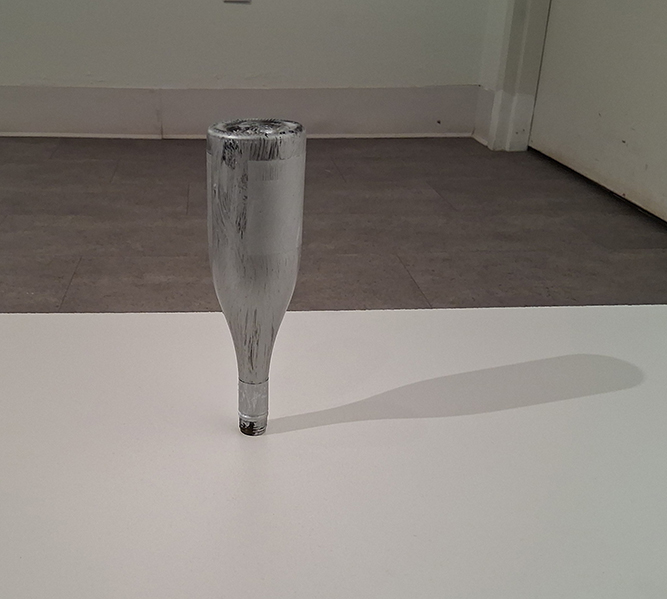
Bill Conger’s upside down bottle.
Conger has gathered together objects from his studio in much the same way. But here he has shared his moments of creation. These artworks and objects are not about relocation, but rather, they are about expression and reinterpretation.
When you visit the gallery at Peoria Art Guild, take a moment. And for that one moment, be the artist.
See Bill Conger’s recent artwork at the Peoria Art Guild, 203 Harrison Street, Peoria IL 61602. Gallery hours are 9 a.m.-4:30 p.m. Tuesday-Friday and 9 a.m.-2 p.m. Saturday. The Peoria Art Guild is closed Sundays and Mondays.