

JOHN HEINTZMAN
In January, the Peoria Art Guild will present its second biennial portfolio in its galleries. For 2026, our portfolio project focuses on photography. The photographers participating in [P26] (Portfolio 26) are Coke Mattingly, Bennett Johnson, Barb Hoffman, Steve Marx, Ann Conver, Liu Yang, Qingjun Huang, Jeanette Crozier, Scott Sternberg, Christopher Gauthier, Jacob Gale, Robert Wilson, Natalie Jackson, Dean Poignant, Dr. Elsberg Clarke, Dr. Scott Moats, David Vernon, and Sarah Eckstine.
[P26] is a boxed exhibition which, as a folio, has compiled and assembled photographs from these artists with an implicit relationship to the Peoria Art Guild and our community. They are dedicated to documenting their world through the lens of a camera. Their professions range from professional photographers, doctors, and educators, all of whom have a distinctive eye for nature, architecture, abstraction, and portraiture. This collective will take us on a tour of their personal experiences, giving us a greater appreciation of our world and our community.
At the close of the 1960s, artists presented a broader definition of photography as fine art. This discipline was evolving beyond simply documentation of an object or space; it was a time when they expanded art’s visual language and ideas. Yet it continued to question itself.
Jacob Gale captures Minnesota landscapes. His work will be on display at Peoria Art Guild after the holidays.
The role of the artist was to answer the question: Is the photo merely a material object or is it an expression of a moment artistically crafted by the photographer? This line of inquiry carried over into contemporary photography, propelling it beyond contrived frames and master prints. In turn, these changes influenced traditional methods of art production, its display, and the manner in which viewers encountered photography as art. Many artists deployed mechanized production of multiples in order to circulate their work more directly to the public — particularly to a larger, younger audience. This provided arts patrons with the means to affordably collect art. Thus, photography became less a “pretty picture” and, more significantly, a work of art.
One artist was Robert Smithson, an Earthworks artist, who used photography to document his landmark installation, Spiral Jetty. Andy Warhol used photography and screen printing to create some of the most memorable portraits of the 20th century; Anselm Kiefer based his monumental paintings on historical photographs filled with angst from WWII. As the [P26] artists, they had the freedom to capture an image drawn from their own world and daily milieu.
These photographers created visual works that combine photographs with personal experiences by introducing process, structure, or techniques that relate to their lives. This Portfolio reminds us that no topic is boring, and a mundane experience can inform an artist’s output. Each of these artists has expressed clarity and an experimental approach to creating. They have achieved artistic vision and integrity with notable works that are unique, communal, and personal.
An exhibition accompanying [P26] Portfolio 26 is, “As I See It,” which will allow the same artists to choose traditional film photography or digital images to express themselves. These singular statements represent their corpus of artwork accrued over the decades.

The influences that we live through often pique our imagination. Barb Hoffman recalls, “The disinfectant pump was a critical part of our lives. Now that the crisis is in the past, it wants to be enshrined for saving us.” A simple functional bottle resonated with an energy that went beyond its obvious usefulness, beyond the label, and the literal disinfectant. Brilliantly, Hoffman has been able to distill those moments into reflection and resolution.
Jacob Gale’s photographs often follow the documentary tradition, presenting images of Minnesota in black and white. His studio practice includes contemporary and analog processes. His ability to capture the nuances of natural settings, the role of the spectator, and the poetic resonance of nature is instilled in each photograph. As an artist, he produces pictures that are literate, genuine, and transcendent. He explores and finds inspiration in family, legacy, inheritance, nature, the built environment, impermanence, and justice.
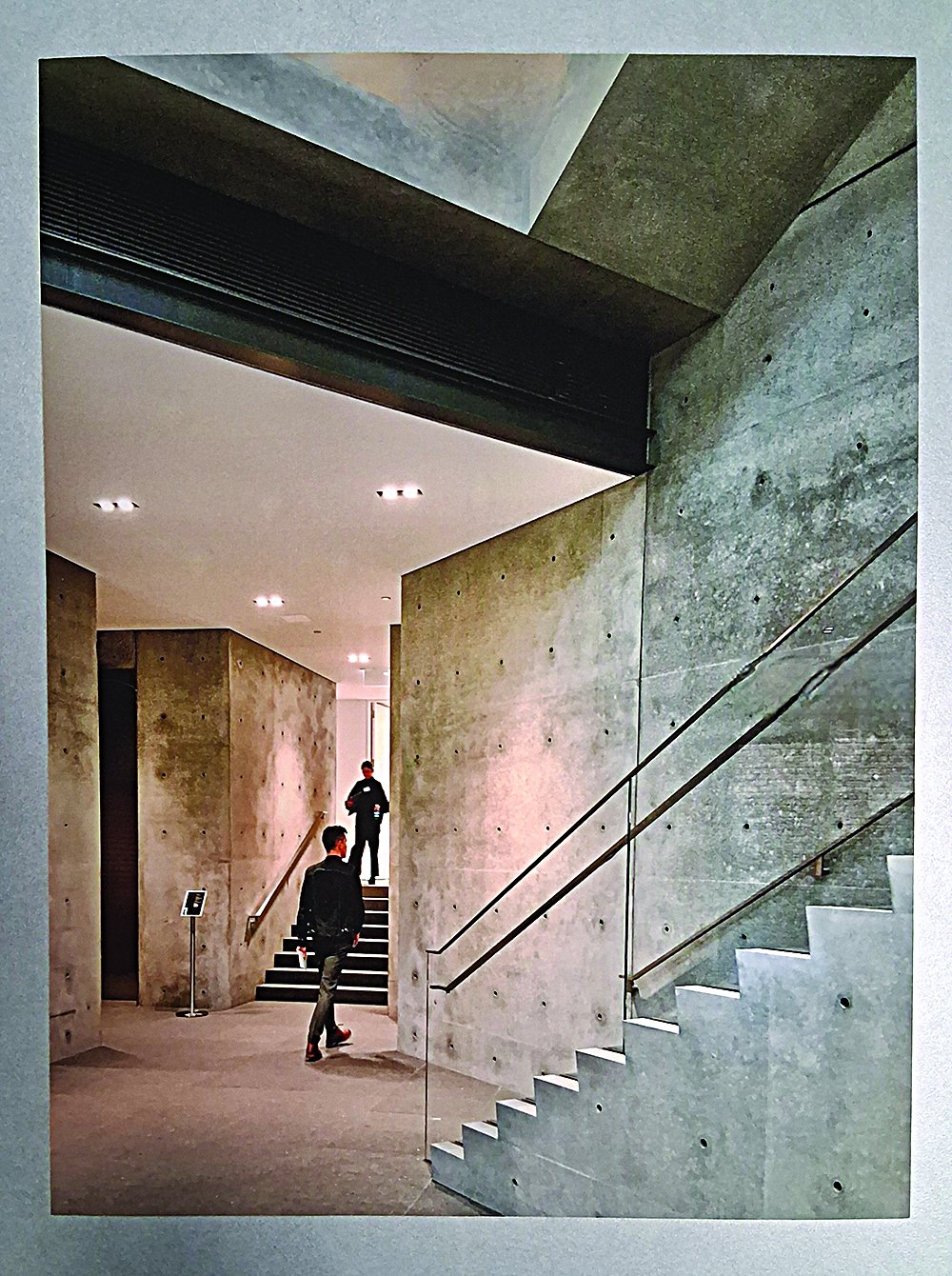
Architect Bennett Johnson relies on his foundation in design and knowledge of the materiality of buildings to create photographic environments that engage the viewer. His brutalist-focused photograph, “Chance Encounter,” is characterized by raw, exposed concrete and bold geometric forms. Johnson utilizes the post-war term to describe his approach to modernism. Brutalism rejects nostalgia and often earlier architectural styles; instead, it presents architectural elements and a tendency to embellish structure. In “Chance Encounter,” he embellishes the structure’s raw, solid elements and directs the viewer’s attention to two figures passing effortlessly through space.
[P26] and “As I See It” will be featured in the galleries in January 2026 at the Peoria Art Guild, 203 Harrison St. Gallery hours are 9 a.m.-4:30 p.m. Tuesday-Friday and 9 a.m.-2 p.m. on Saturday. Admission is free and open to the public.