

NICHOLE GRONVOLD ROLLER
Randall Carlson has been a ceramic professor at Bradley University since 1993, and brings a wealth of experience and a diverse artistic background to his work. The Illinois native studied under Mauricio Lasansky and Keith Achepohl as he earned an M.A. in printmaking from the University of Iowa, and attained an M.F.A. in ceramics from Bradley under the guidance of James Hansen.
With a deep understanding and intricate skill set, Carlson creates salt-fired ceramic artworks rooted in a rich history. He has worked in production potteries across Minnesota, Maine, and Wisconsin. His studies and residencies have taken him to Europe and Japan, where he acquired knowledge of constructing wood-fired kilns, ceramic history, and various glazing and firing techniques.
His utilitarian ceramic works are elegantly formed and simplified with a restrained focus on form and color. Crafted with meticulous care, they feature glazes that enhance their shapes and reveal the history of their firing. The earthy tones, with traces of copper and iron, further enrich their visual appeal.
Salt firing demands constant monitoring, precise adjustments, and extensive preparation. However, its unique and beautiful results make it a gratifying endeavor.

RANDY CARLSON
“Once you commit a kiln to salt firing, that’s pretty much what you’ll use it for,” Carlson explains. “The salt glazes the brick just like it glazes the clay.
“The salt volatilizes and sits like a cloud” using plain table salt that vaporizes instantly when introduced to the firing.
Has Carlson built the kilns at Bradley? “Every kiln that has been built at Heuser (Hall), I either built or helped to build,” the artist replied. “When Heuser was finished, I was a grad student of Jim (Hansen), and some of us upper-level students built the first two gas kilns in about 1988. Those lasted until after I returned to BU as a faculty member. As those kilns needed to be rebuilt, I did them from then on. Some were with some student help.”
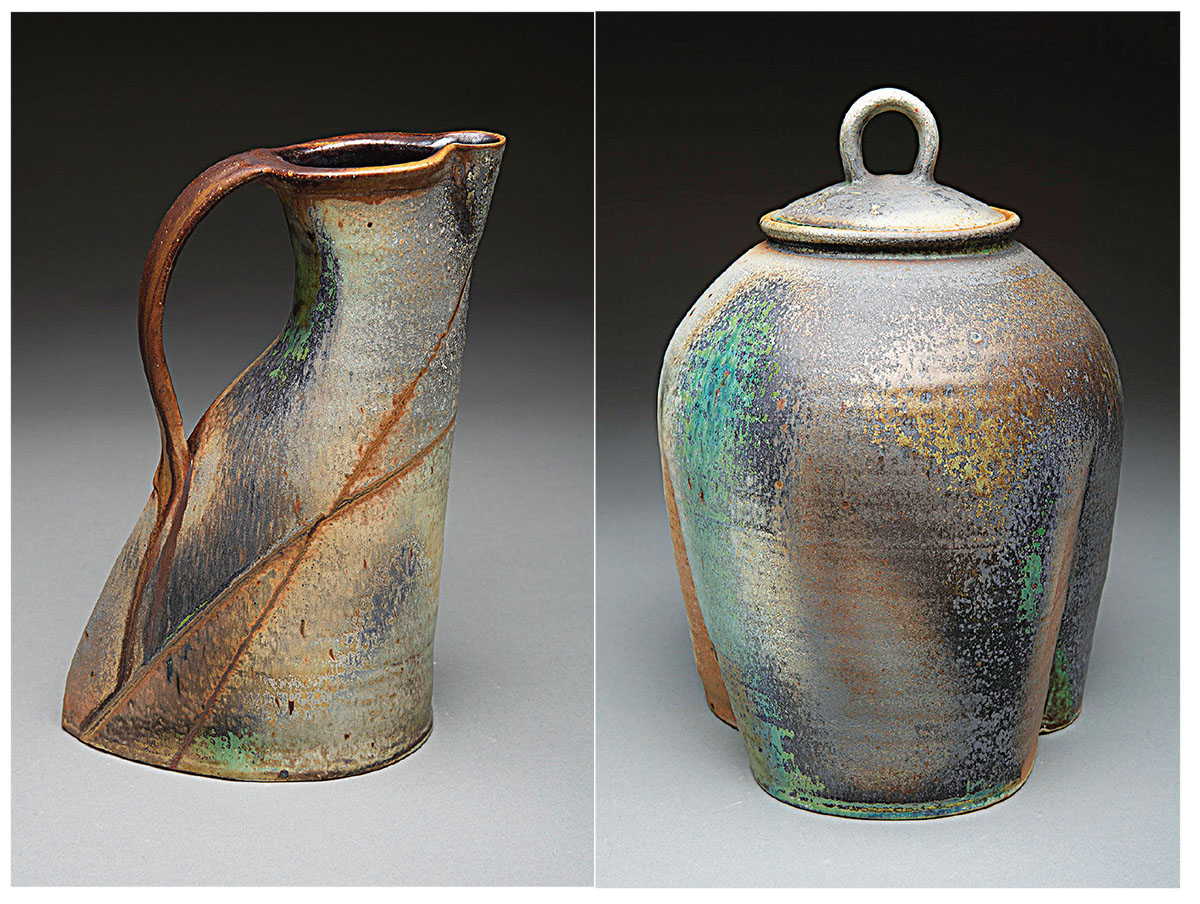
Salt-fired stoneware, thrown and altered with copper and iron glazes with titanium by Randall Carlson. LEFT: Pitcher, 12x7x3.25 inches. RIGHT: Covered jar, 13x11x10 inches.
On the day he plans to start a salt firing, Carlson loads the pieces into the kiln and bricks up the entrance by mid-afternoon. Firing continues on a low setting until about 7 or 8 p.m. Carlson returns around 10:30 that night to increase the temperature and ensure the kiln won’t exceed the desired temperature when he returns. By 4-4:30 a.m., Carlson is back to check the kiln. After this point, he makes adjustments every hour, sometimes even at half-hour intervals, to ensure the heat is evenly distributed from top to bottom.
This careful monitoring helps to create enough pressure to achieve an even temperature distribution. Carlson continues with incremental adjustments until the kiln reaches a specific temperature. During this phase, the kiln might heat unevenly, often hotter at the top. He addresses this by creating sufficient pressure to push heat to the bottom, striving for evenness. Once the desired temperature is reached, Carlson makes the final adjustments to set a reduction atmosphere in the kiln, which starves it of oxygen and helps achieve the specific color effects he desires. Post-firing, the kiln needs time to cool down, which can take up to a day or more.
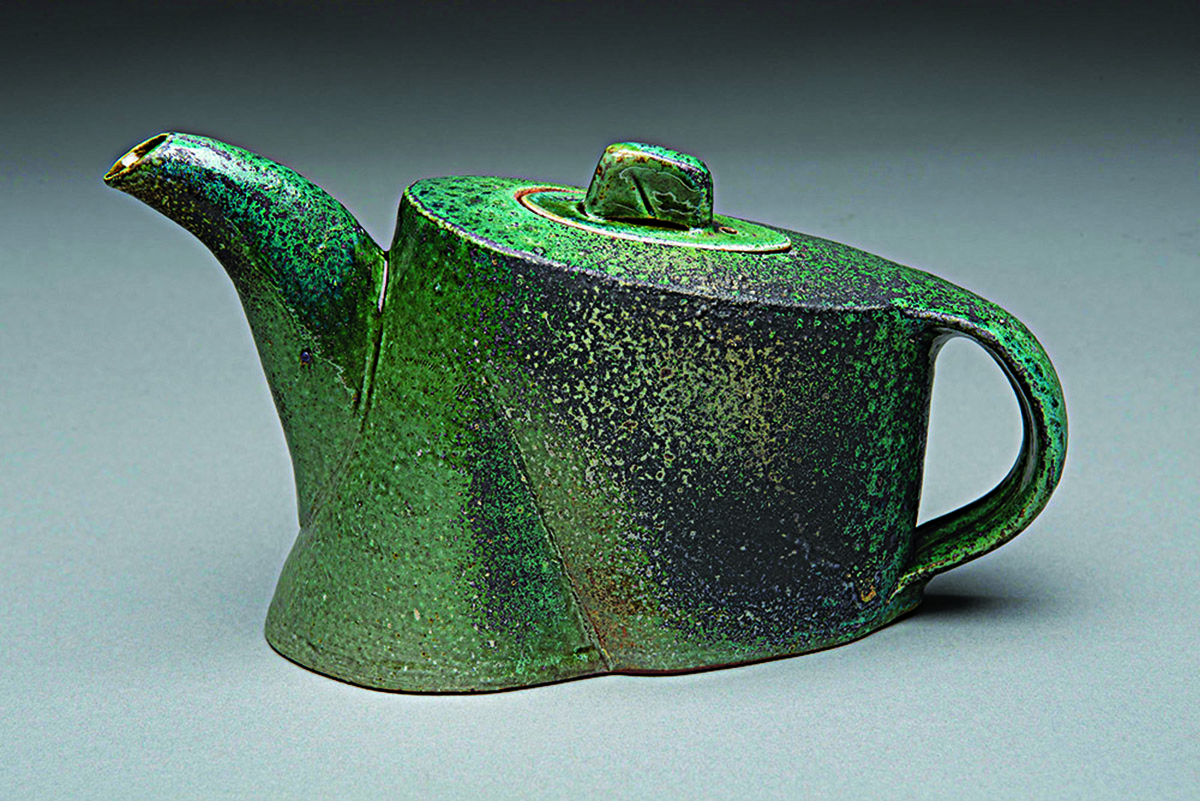
Teapot by Randall Carlson. Thrown, altered and assembled, salt fired with copper glaze and a titanium overspray, 4.5×7.5×3.
“Once the form and attitude of the forms are established, I strive to create surfaces with rich color and textural variations that are established in a sodium-fired atmosphere,” he said. His work involves creating these variations with copper and iron glazes in a sodium-fired atmosphere “pursuing a narrow range of glaze materials to achieve evolving colors and textures.” He aims to produce familiar forms that echo traditional pots while offering a contemporary and personal interpretation.
During a recent tour of his home studio, Carlson and his wife Sandy shared some of their favorite pieces from their ceramic collection acquired throughout the years, including a small pitcher by British salt glaze potter Walter Keeler and a soda-fired tea bowl by Jeff Oestreich.
As an undergraduate at Luther College in Decorah, Iowa, Carlson met Marguerite Wildenhain, a Bauhaus-trained ceramic artist, author, and educator whose renowned works are part of the Luther College Fine Art Collection. Carlson’s collection includes two pieces by Wildenhain: a small beaker and a footed bowl with handles.
Carlson’s influence expands through his founding of Central Time Ceramics, a program for showcasing contemporary ceramics across the Central Time Zone. His work, featured in publications like 500 Pitchers, demonstrates his ongoing contribution to ceramics.
Carlson is projected to retire from teaching at Bradley after the 2024-25 school year and is relocating exclusively to his home studio. He leaves behind a lifelong legacy that has influenced many. His expertise and commitment inspire students and artists alike. Carlson’s ceramic works blend precision and artistic expression, making it both a challenging and rewarding practice. As he transitions to dedicating his time as a full-time artist, we extend our gratitude to Randall Carlson for sharing his wisdom and passion through his art.