
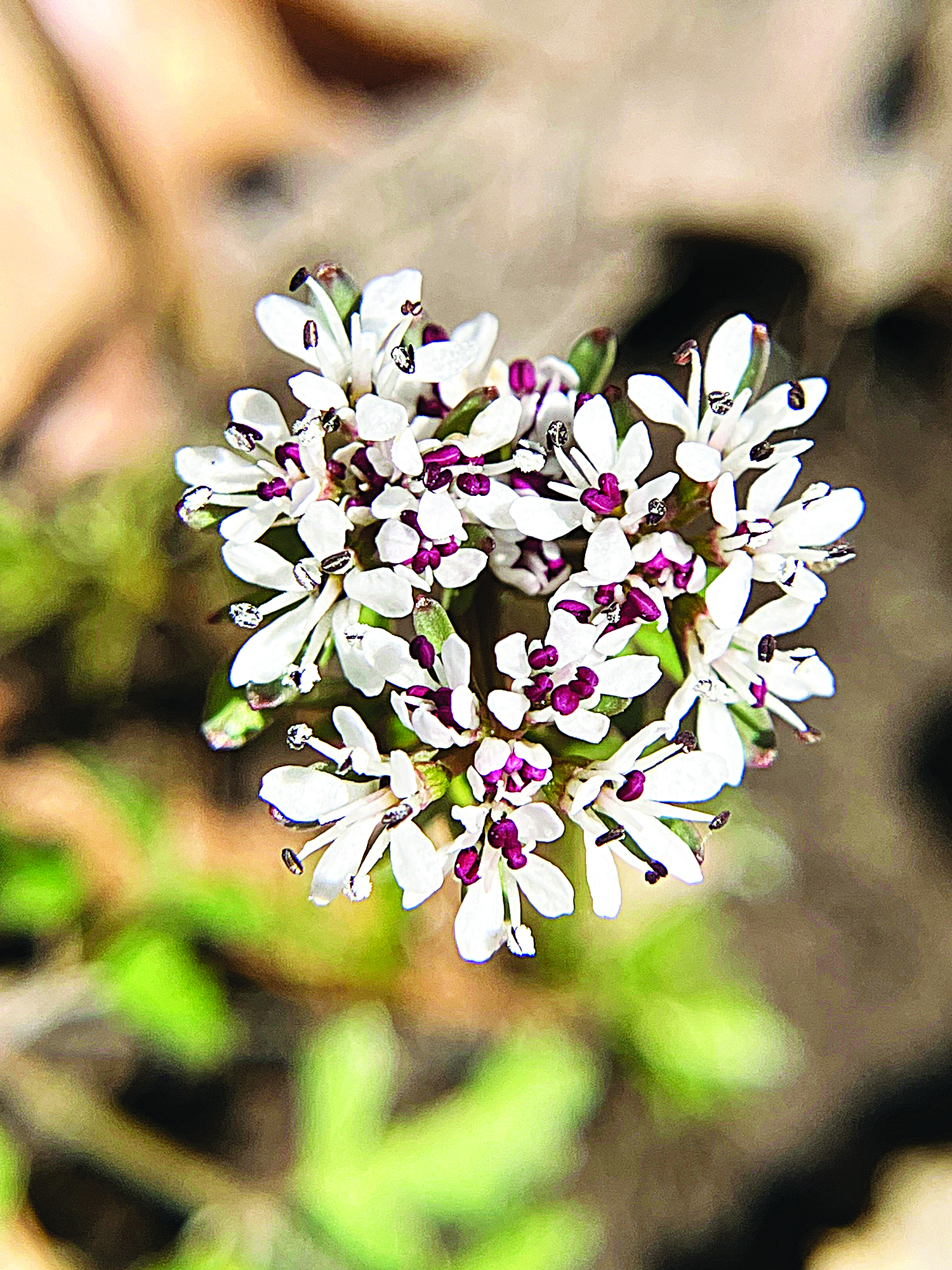
The tiny flowers of Harbinger of Spring (Erigenia bulbosa) in bloom late March in Moraine View State Park in McLean County.
MIKE MILLER

MIKE MILLER
Exploring Illinois woodlands in March is an exercise in attention. The trees are bare, their branches forming intricate silhouettes against pale skies, and without summer’s leafy canopy, sunlight reaches the forest floor in generous pools. These brief weeks of light are everything to spring ephemerals — plants that race through their life cycle before the woods grow dim again. Walking slowly, eyes trained low, you begin to notice subtle signs of life. A hint of green punctuates last autumn’s leaves as desiccated mosses miraculously spring back to life. As your mind becomes attuned to these subtle awakenings in the forest, you find the first flowers of spring. The faintest blush of pink and white appears where only browns and grays existed moments before, signaling that your careful attention has been rewarded. The aptly named Harbinger of Spring, Erigenia bulbosa, calls to you.
For decades, I have searched out this diminutive wildflower in the March woods of Peoria County, and for decades I have failed. I still haven’t given up hope, and it will likely be a search I continue for as long as I can ramble through the March woods. But just a few miles to the east in McLean County it is easily found. A stroll along the Tall Timber Trail at Moraine View State Park is worth a pilgrimage to find the diminutive Harbinger of Spring. Be ready to get down on hands and knees to seek it out, because it is tiny. When blooming, each plant stands only a couple of inches tall, topped with a small number of rounded clusters of tiny white flowers with prominent pinkish anthers.
The distribution of this plant in Illinois is scattered throughout the southern and eastern parts of the state and mysteriously absent in other counties. Because of this scattered distribution, the plant has taken on a peculiar role among botanists. Its diminutive size can lead to it being overlooked, but keen-eyed botanists have been looking for more than a century, so finding new colonies in areas where it has not been found before has become a bit of a game among searchers — a challenge to exercise the mind and rekindle the senses.
There is also a deep, grounding pleasure in the physical act of walking these woods in early spring. Boots grow muddy, fingers chill when the wind shifts, and jackets are shrugged on and off as the sun appears and disappears. Yet these small discomforts only sharpen the experience. They root you in the present moment, making the sight of a tiny blossom feel monumental, a triumph earned through patience and persistence.
By the time you leave the woods, perhaps having found the Harbinger of Spring — or perhaps not — you carry something with you regardless. It may be the image of a delicate flower glowing in a shaft of sunlight, or simply the knowledge that the forest is awakening, quietly and inevitably. In Illinois, March is not yet spring in full voice, but in the same brief shafts of light that once illuminated bare forest floors, it is already whispering its promise.