

MIKE MILLER
It was 10-years ago that tree lovers designated October as “National Oak Awareness Month.” The goal was to promote awareness of the crucial role oak trees have on the planet’s health. Here’s a link to a past Nature Rambles from 2015 that dives into the first OAKtober celebration at thecommunityword.com.
Oak trees are one of the most diverse family of trees in North America. There are more than 500 species of oaks worldwide, 90 species are native to the United States, and 20 are found in the state of Illinois. They are considered a “keystone species” because of their role as a food producer. Their plentiful seeds (acorns) are packed with nutrition for birds and mammals, while their leaves are prime food for leaf-eating insects. Oak leaves are consumed by more than 900 species of butterflies and moths alone. No other tree family comes even close in the edibility contest. That abundance of insect activity brings in a plethora of insect eaters. Oak woodlands fuel the migration of songbirds in the spring and fall. If you are a birder and want to see one of the dozens of warbler species during spring migration, look to the young leaves of any oak tree during early May.
When the oak leaves have dried and fallen from the tree, they still play a crucial ecological role. Oak leaves fall from the tree “dry and curly.” They create a leaf layer full of nooks and crannies that are crucial for the survival of over-wintering insects such as fireflies and bumble bees. Oak leaves are one of the most beneficial natural mulches that can be incorporated into your landscaping. You might have heard of the “Leave the Leaves” movement that encourages the use of leaves as a natural mulch. If you have oak trees in your yard, incorporate the leaf litter into your mulch beds. Not only will it provide crucial habitat for pollinators, but it will also help recycle nutrients to your trees. Besides, using the leaf litter as an asset rather than treating it as a landscape waste just makes sense.
Even though oak trees are long-lived, relatively tolerant of drought, and adapted to fire prone habitats, our mighty oaks are struggling. You might have heard the Harvest Public Media segment on WCBU, Peoria Public Radio “The King of the Great Plains is dying.” It chronicles the plight of the majestic Bur Oak in Nebraska, and how entire swaths of historic trees are succumbing to hypoxylon canker. This deadly fungal disease is more prevalent in extreme southern states, but prolonged drought and a warming climate is allowing it to spread north. It is one of many diseases that are taking its toll on oaks throughout the Midwest.
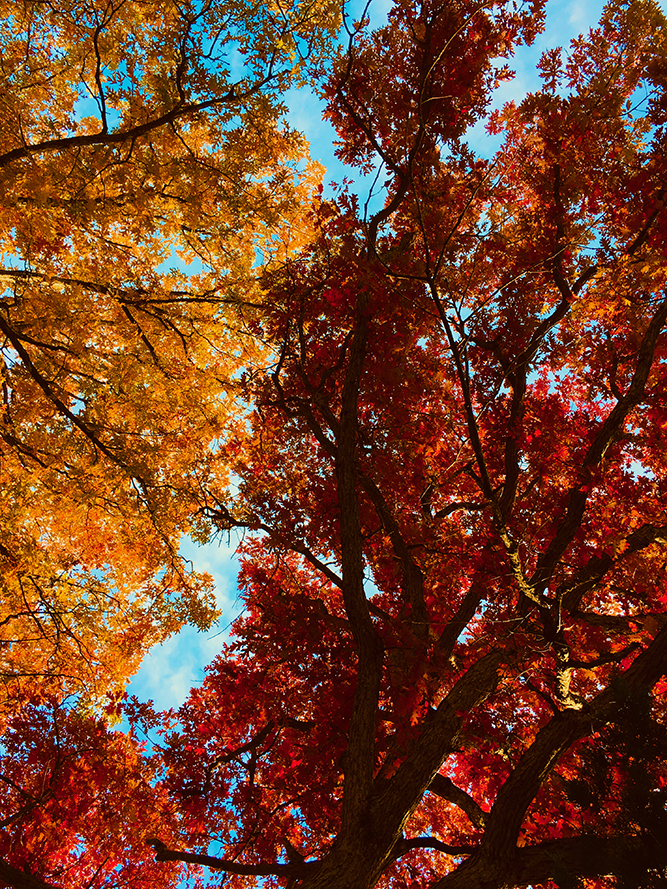
Fall colors in oak trees at Singing Woods Nature Preserve.
MIKE MILLER
The effects of climate change have combined with other human influences such as increased pesticide use. A recent report by the Prairie Rivers Network to the Illinois State Nature Preserves Commission found that plants were impacted by herbicide drift even though they were miles away from any herbicide application. It is just another impact that weakens the oak tree’s ability to survive.
For their part, oaks have enjoyed a long reign as king of the climax forest throughout the Midwest. The 300-plus-year-old oaks that grow in our parks today were young and hale when the industrial revolution first started to take shape. Most of their lives were spent in a time when human influence on the climate was rather minimal. In the last 50 years, the effects of human influences on climate have exponentially grown and outpace the oak’s ability to adapt. Some think it is controversial to discuss human influences on the environment, but I think it is crucial for our understanding of ourselves as a species. Humans are successful because of our ability to adapt so quickly. We are witness to monumental social and physical changes each generation. When my father was born, airplanes were bi-planes covered in canvas and flew around 70 miles per hour. Now, we are building airships that can fly to other planets. Humans are adept at influencing their environment. Other species find that difficult, if not impossible to cope with.
So, what does this mean for our oak trees? That depends on us. Can we slake our thirst for fuels that alter the atmosphere? Our species has shown incredible aptitude to adapt. But the first rule of being successful at adapting is to thoroughly understand our options. Currently, we are on a bit of a backslide in this skill set. We have erased decades of climate data and squandered our knowledge by shuttering our scientists. Meanwhile our oaks slowly die in silence. One of the most successful and important species for life on our planet is trying to tell us something. Will we have the wisdom to listen?
This story first published Oct. 7, 2025