
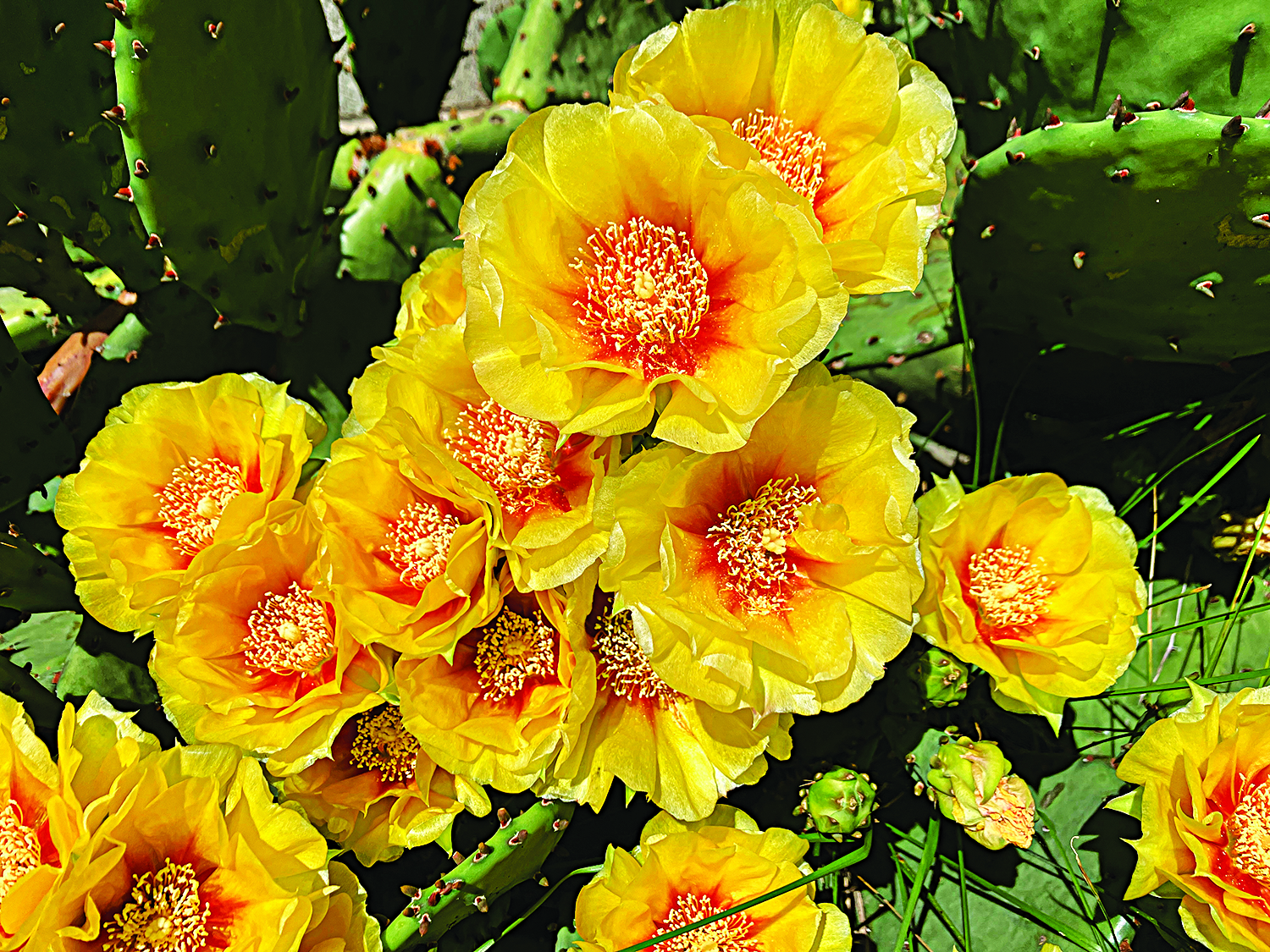
Showy — and fleeting — blooms of Eastern Prickly Pear (Opuntia humifusa) in a garden planting. Seeing some of these flowers is a special treat as they may only last a day before withering away.
MIKE MILLER
June is the perfect month to ramble through a prairie. While the woodlands have progressed past the spring wildflower season, prairie wildflowers are just getting started. Illinois woodland wildflowers tend to bloom early, before the leaves fully develop in the overhead tree canopy. Sunlight is an abundant commodity in the prairie, so there is no shortage of summer wildflowers here.

MIKE MILLER
If you happen to be taking your June stroll through a prairie with sandy soil, you might come across the Eastern Prickly Pear (Opuntia humifusa). We don’t think of cactus as being native to Illinois, but in fact there are three species of prickly pear that can be found here. The Eastern Prickly Pear, though, is the most common and found throughout the state where sandy soils are present. Prickly pears tend to grow as flat “beaver-tail” shaped pads. At the top of the pads, more pads can grow, until you get a chain of 2-3 pads. These pads tend to be bluish green in color and are evergreen, surviving winters as wrinkled pads only to revive and fill out again each spring.
If you attempt to handle the pads, you are likely to understand why it is called “prickly.” There are several diagonal rows of air pores, or areoles, scattered across the surface of the pads. Tiny green, succulent leaves can form at these areoles in the spring. As the plant matures, the leaves tend to be replaced by either a long gray spine, or more commonly a growth of a small cluster of short wooly hairs. This structure is called a glochid, and even though the hairs are tiny, they can be quite painful once they work their way into the skin.
Mid-June is when they tend to bloom in Illinois. Mature plants can produce a huge display of their bright yellow blooms that can be 2-3 inches across. These flowers form from buds at the top edge of the rounded pads. On some plants, the inner part of the flower petals will be orange or red. Each plant can produce many flowers throughout the season, however, each flower only lasts a day. The flowers are regularly visited by a wide variety of native bees who seek out nectar that is stored in the base of the bloom. In trade for nectar, the bees must crawl through a dense ring of pollen bearing anthers. As the bee crawls through the flower, it causes the plant to react by curling the anthers downward, making sure the bee gets a good dose of pollen. This curious ability of a plant to react to the stimulus is called a thigmotactic reaction. You can see it happen if you touch the pollen bearing anthers of the bloom. A remarkable example of how plants and their pollinators have evolved a complex interdependence.
After the flowers bloom, an oval shaped fruit is produced. It becomes brownish-red as it matures. Inside are seeds surrounded by a sweet-tart pulp that entice animals to help distribute the seeds. Despite its prickly nature, humans have had a long history of utilizing the pads and fruits as a food source. Once the prickly skins of the fruits and pads are removed with care, it becomes an excellent source of antioxidants and nutrients.
New plants can be generated by seed or vegetatively by loose pads re-rooting. This is the easiest way to get Eastern Prickly Pear established in a garden. Just make sure you pick a place where you are not likely to brush up against it. If you do get a batch of glochid spines embedded in your skin, apply sticky duct tape to the area and pull. If you would rather visit them in their natural environment, Henry Allen Gleason Nature Preserve in Mason County is an easily accessible location to explore.