
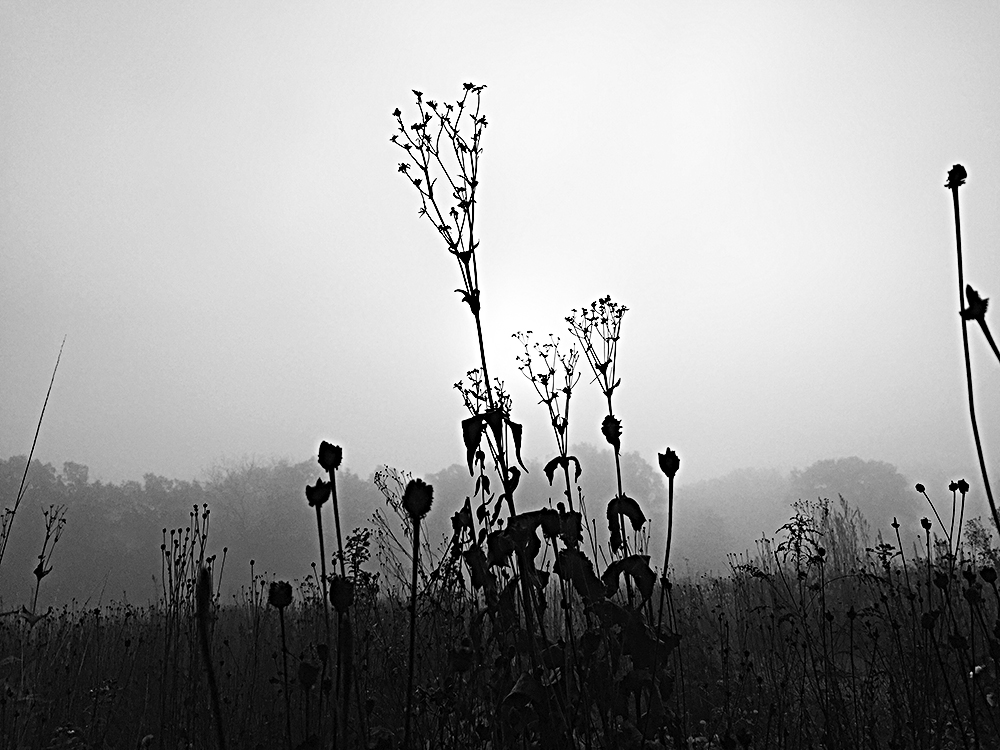
Dormant stalks of cup plant and coneflowers greet a cold November morning on a prairie remnant in Peoria County.
MIKE MILLER
The prairie in November is a study in endurance. Its colors have faded from green to copper and rust, yet nothing here feels lifeless. Cup Plant and Compass Plant stand like weathered sentinels, their sandpaper-like dried leaves rattling in the wind. The air smells of rich earth and a promise of snow. I follow a narrow trail through the tall grass, each step stirring the dry whisper of stems. At first, the landscape seems silent, but the longer I listen, the more I hear — the hum of what remains and the quiet strength of what waits beneath.

MIKE MILLER
By mid-November, the prairie has surrendered its surface life. The goldenrods are gone, the asters spent, the monarchs long departed. But the land does not mourn their passing. Beneath the crisp mat of grasses lies a dense web of roots and fungi, holding the soil together and storing life for spring. Some reach deeper than a person stands tall, winding through the earth to find the memory of moisture. This is where the prairie keeps its pulse — not above, but below.
Frost lingers in the shaded swales, a thin silver crust over the seed heads of goldenrods. The wind moves constantly, a low breath that never stops. When I pause, I can hear a red-tailed hawk cry somewhere beyond the horizon, its sound thin but sure. The prairie is never truly silent; it just speaks in a slower rhythm.
I remember this same place in July, blazing with coneflowers and compass plants, bees tumbling among their petals, meadowlarks singing from the fence posts. That summer abundance feels far away now, yet its ghost lingers — the memory of color and motion stored deep in the soil. The prairie knows how to wait.
Beneath the tangle of stems, insects overwinter in the litter’s shelter. Voles and mice tunnel through it, leaving faint trails where frost has melted. Hawks trace lazy circles above, patient and precise. Even in this stripped-down season, the food chain hums quietly on. The prairie never stops working; it simply moves at a different pace.
I crouch and touch the soil, cold and coarse between my fingers. Somewhere beneath my hand seeds lie waiting — dropseed, bluestem, milkweed — each sealed tight against the cold, trusting the slow turn of the earth. Their patience humbles me.
The sun drifts lower, laying gold across the grasses. For a moment, the whole prairie glows as if it remembers summer’s heat. The wind bends everything eastward, a slow bow toward winter. I think of how much prairie once covered this state — millions of acres — and how little remains. Yet even in fragments, it endures, carrying its resilience in roots that outlast frost and flame.
As I turn back, the light fades and a flock of geese cross the sky, their calls echoing through the chill. The sound passes quickly, leaving behind a silence that feels earned.
The prairie’s lesson is not about beauty or loss but endurance — the quiet work of holding on through the cold, trusting what waits below. The prairie remembers everything: fire, frost, and the buzz of wings — and in its deep roots, it holds the promise that life, even unseen, is never gone.