

MIKE MILLER
Their wingbeats could be heard before the birds were even visible on a quiet, foggy morning in downtown Peoria. Then their voices rang out — a loud, resonant, sonorous, bugle-like call echoing across the still water. A sound that was once common on the Illinois River 200 years ago has only recently returned.
Breaking through the fog, they finally came into view: a flock of enormous white birds. With wingspans exceeding seven feet and weights approaching 30 pounds, the Trumpeter Swan is the largest native waterfowl species in North America. Once, this impressive bird nested widely across the upper United States and Canada, including Illinois. By the end of the 19th century, however, the species was believed to be extinct across most of its former range. Today, Trumpeter Swans can once again be seen gracing the skies of the upper Midwest.
During the Dec. 20 Peoria Christmas Bird Count, observers recorded a remarkable 22 Trumpeter Swans — a record high. This is especially notable given that the species has only been documented five times in the 126-year history of the count (2015, 2019, 2021, 2024, and 2025).
Endangered
There are three species of swans found in the United States and distinguishing them takes some practice. The rarest in the Midwest is the Trumpeter Swan, a very large, all-white bird with a black bill. The Tundra Swan, another native species, is slightly smaller and also has a black bill, but usually displays a small yellow spot in front of the eyes. The third species, the Mute Swan, is an introduced bird with an orange bill with a prominent black knob at the base. Mute Swans are the most common in central Illinois and are often year-round residents. When swimming, Mute Swans typically hold their necks in a graceful curve, while Trumpeter and Tundra Swans tend to keep their necks straighter.
The Trumpeter Swan’s decline was an all-too familiar story. Throughout the 1800s, market hunting for meat, the hat industry’s demand for feathers, and the use of swan skins for powder puffs led to intense exploitation. For instance, the Hudson’s Bay Company shipped more than 26,000 swan skins to England between 1804 and 1819. This overhunting, combined with widespread habitat loss, caused the species’ rapid decline. By 1900, Trumpeter Swans were believed to be extinct.
Fortunately, a small, non-migratory population was discovered in remote mountain valleys of Montana, Idaho, and Wyoming. In 1919, two nests were found in Yellowstone National Park, confirming the species’ survival. To protect these remaining birds, Red Rock Lakes National Wildlife Refuge was established in Montana in 1935. With protection, the population slowly increased, reaching about 640 birds by the late 1950s. Around the same time, aerial surveys of Alaska’s Copper River region revealed another population, which became a crucial genetic reservoir for the species’ recovery.
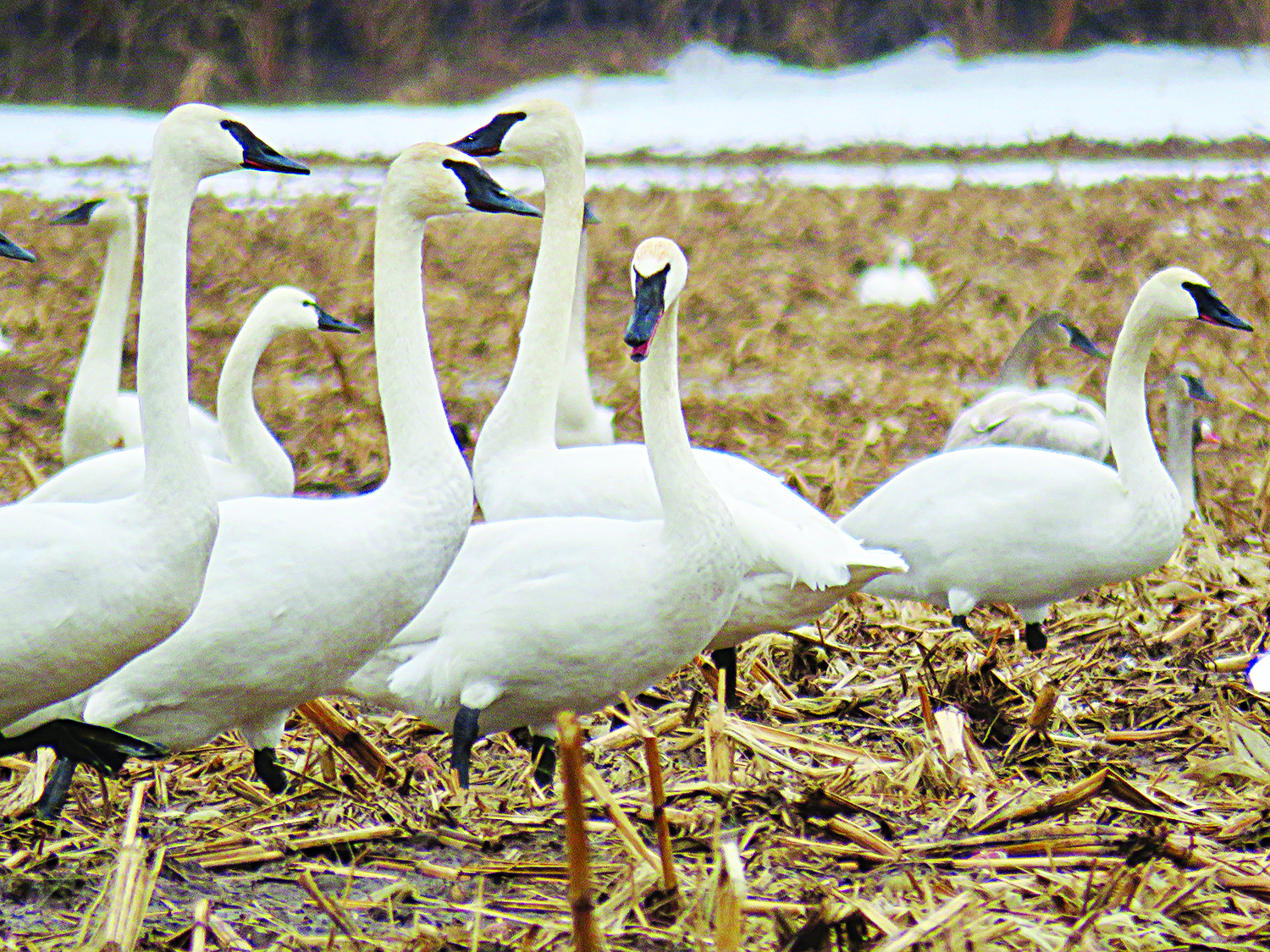
A flock of several Trumpeter Swans and a lone Tundra Swan (left background) feed in a farm field south of Havanna in Mason County.
PETE FENNER/PEORIA AUDUBON SOCIETY
Transplanted
In the upper Midwest, Trum-peter Swans were reintroduced into Minnesota using birds from the Red Rock Lakes population. Recovery was slow and costly, with numbers fluctuating as the program expanded. New threats emerged, such as severe lead poisoning from swans ingesting spent lead shot in wetlands. Despite these challenges, by the early 1990s, the upper Midwest population had grown to about 600 birds. Growth accelerated in the 2000s as Minnesota’s reintroduction effort expanded into Wisconsin and Michigan. By 2015, the interior Trumpeter Swan Population was estimated at more than 27,000 birds.
This remarkable comeback is both dramatic and heartening, reflecting decades of dedicated work by private conservation groups, state wildlife agencies, and federal partners. Although it stands as one of North America’s great conservation success stories, it often goes overlooked. To catch a glimpse of these impressive birds during the winter, visit local wetlands such as Banner Marsh in southern Peoria County, Spring Lake in southern Tazewell County, Chautauqua National Wildlife Refuge in Mason County, or Emiquon Preserve in Fulton County. This year, they have also been sighted more locally all along the Illinois River and also in western Peoria County in some of the lakes and farm fields near Elmwood. By early spring they will begin migrating back to nesting territory to the north.
Winter may not seem like the ideal time to explore wetlands, but the swans would disagree. Bundle up, head out, and listen for the echo of their calls across the water. While Illinois does not yet have nesting Trumpeter Swans, there is reason for hope. Neighboring Iowa is home to around 600 birds, and breeding populations are well established in Minnesota, Wisconsin, and Ohio. The sound that once vanished from the Illinois River has found its way back.