
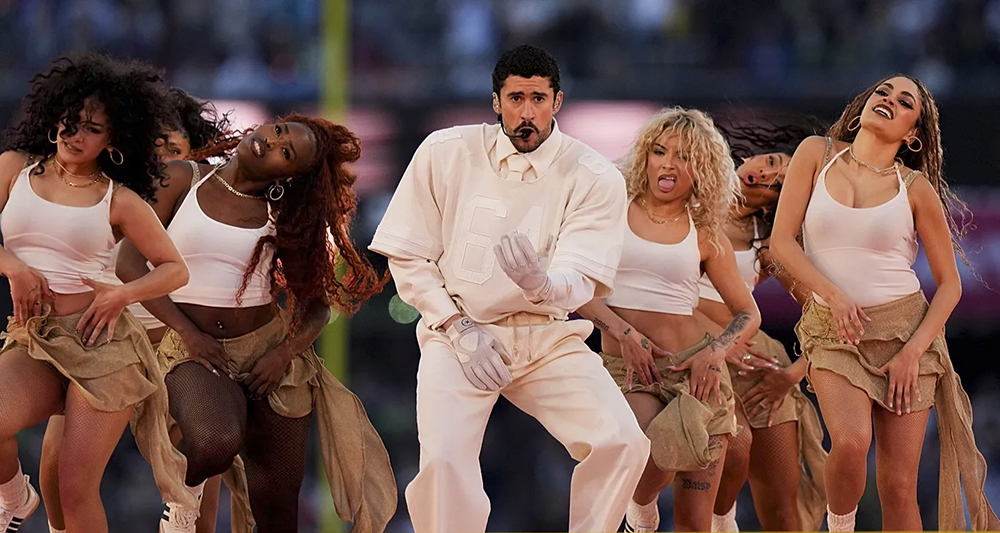
Bad Bunny (center) performs at Super Bowl LX in Santa Clara, Calif.
ASSOCIATED PRESS
While many past Super Bowls have been controversial, this one felt different. At least for our lifetime, there hasn’t been a more decisive and divisive halftime show — especially with the emergence of two halftime shows. The NFL scheduled Bad Bunny to play during the official halftime; Turning Point USA (TPUSA) organized the “All American Halftime Show,” with headliner Kid Rock. The controversy surrounding Bad Bunny and who he is was substantially more than what we’ve seen before, and unfairly so.
The TPUSA Halftime Show was a response to the backlash that surrounded the NFL Halftime Show, which was lowlighted by President Donald Trump posting on Truth Social, “The Super Bowl Halftime Show is absolutely terrible, one of the worst, EVER! It makes no sense, is an affront to the Greatness of America, and doesn’t represent our standards of Success, Creativity, or Excellence. Nobody understands a word this guy is saying, and the dancing is disgusting, especially for young children that are watching from throughout the U.S.A., and all over the World.”
The Peoria Academy Journ-alism Club disputes these claims and disagrees with his review of the show. Primarily, there is a large Spanish-speak-ing population in the U.S., and obviously, in South America who would all be able to understand the show. Another claim was that the Super Bowl is a pillar of American culture, and “should not include any Spanish speaking.” However American culture is more than the stereotypical American. It includes a diverse collection of languages, people and culture, which should be represented in such an important show.
The Turning Point USA show featured Brantly Gilbert, Lee Brice, Gabby Barrett, and the headliner, Kid Rock. The performance was described in many different ways. Melinda Newman, a writer for Billboard Magazine, described the performance as “a respectful, enjoyable presentation that Kid Rock had promised, which appealed to the conservative base.” Others such as Chris Murphy, a writer for Vanity Fair, wrote “The ‘All-American Halftime Show’ was a spectacular failure. There was nothing special or bespoke about it — just four performers preaching to the choir on a big, empty stage.”
The Journalism Club watched highlights from both performances and we believe that the Bad Bunny Halftime Show was considerably better than the TPUSA one. During the alternative Halftime Show we noticed many symbols of the United States, including white stars and stripes. The show was referred to as the “Real American Halftime Show” but we noticed that the performance had no diversity. With only having one type of American in the show, we felt like the performance was not being inclusive and did not recognize the many cultures we have in the United States. On the contrary, we felt the Bad Bunny show was inspiring and inclusive. During the show he gave a “younger Bad Bunny” a Grammy Award (which he had won the previous week) to show how you should always dream big and follow your goals. At the end of his performance, text was shown on the billboard behind him, saying “The only thing more powerful than hate is love.” At the end of the TPUSA show, the billboard behind the singer showed a QR code asking for money to support the organization.
Nick Adams, a best-selling author, wrote in a post on X, “Was a single word of English spoken during the Super Bowl Halftime Show? Someone needs to tell Bad Bunny he’s in America. This is an abomination.” This language difference was a positive for many Spanish speakers who felt like their culture was seen. In addition, there was a performance by Lady Gaga, who sang her hit song “Die With a Smile” completely in English. Nobody in the Journalism Club was able to understand what Bad Bunny was saying, but we were still able to enjoy the music and appreciate the performance. It is unclear to us why others were unable to do the same and show respect for the official Halftime Show.
Bad Bunny’s Super Bowl Halftime Show was a vibrant and colourful celebration of Puerto Rican heritage, featuring a barber shop, a coconut cart, jewelry stand and a nail tech station. There were other symbolic elements, such as the sugarcane fields that Bad Bunny walked through and the electrical cable poles that he climbed. Throughout the show, a love story was being told. While in the sugarcane field, Bad Bunny is seen getting a ring from a jewelry stand, and giving it to a man, who then proposes to his partner. Later in the show, a live wedding occurred, with that same couple getting married. Many celebrities were seen, including Pedro Pascal, Cardi B, and Alix Earle. Bad Bunny also brought singer Ricky Martin, who sang a line of “Lo Que Le Pasó a Hawaii” alongside Bad Bunny.
The official Halftime Show was impactful in more ways than just sparking outrage, it showed the history and culture in Puerto Rico, and offered representation as the first all-Spanish speaking Halftime Show. Coming back to school after Super Bowl Sunday, what we talked about were the celebrities, the songs that we knew and the dancing, not that we couldn’t understand it. We talked about “DtMF” (A song from Bad Bunny’s new album) being short, because we had learned about it in Spanish class. It was exciting for us, and obviously for the 128 million people who also watched it.
— By Ammini Guzzardo, Iyla Robinson & Anonymous