
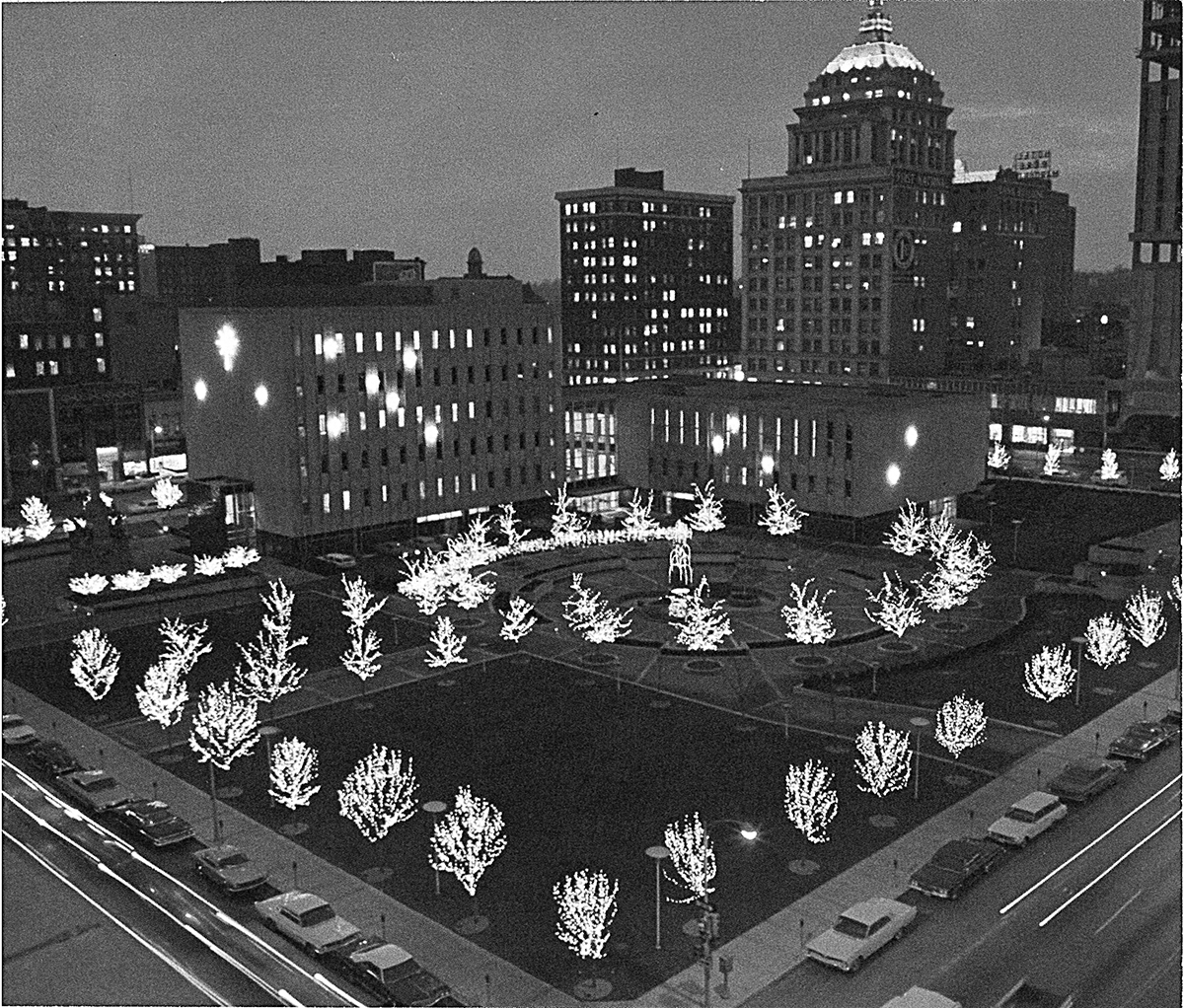
This photo shows the Peoria County Courthouse at night in the 1960s, before the five-story addition fronting Jefferson and Hamilton was built in the 1980s. Note the Riverview Plaza building still under construction in the upper right corner.
PHOTO COURTESY PEORIA COUNTY
The 1960s were an era of upheaval for Downtown Peoria, as the brown brick buildings of the 19th and early 20th centuries made way f or the gray, modernist high-rises that still stand prominent on the city’s skyline today. Indeed, someone who hadn’t set foot in the central business district since 1960 would be hard-pressed to recognize much of it by the dawn of the ’70s.
The new Sears department store opened in 1965 on the block now home to the Peoria Riverfront Museum and Caterpillar Visitors Center. Caterpillar’s new $7 million world headquarters, erected on a two-block footprint bounded by Adams, Main, Hamilton, and Water streets, was topped off in 1967. The 20-story Savings Building (now Riverview Plaza) was also completed at 411 Hamilton in 1967. The Security Savings & Loan Building (now Caterpillar Building AH) was also built in this decade.
But it was the new $4.5 million Peoria County Courthouse, which brought America’s First Lady to Peoria 60 years ago this September. The L-shaped, 111,000 square foot structure replaced the beautiful, yet outmoded, 47,000 square foot Venetian-style structure built in 1876.
The Peoria Journal Star’s editorial board believed it was the courthouse block’s landscaped outdoor plaza that drew Lady Bird Johnson’s attention just as much, if not more so, than the modernized seat of justice.
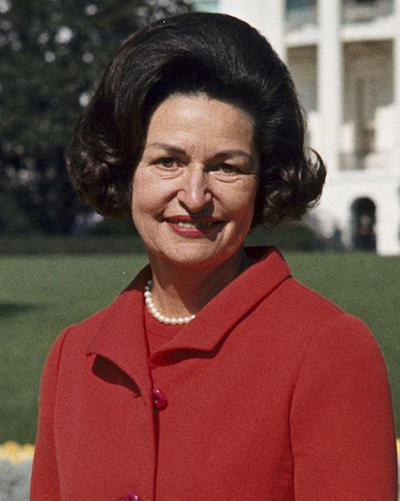
Ladybird Johnson
The First Lady was a champion for public beautification efforts in the 1960s, and her remarks at the rainy Sept. 22, 1965 dedication of the new Peoria County Courthouse indicate she was pleased by what she saw in Peoria — which she dubbed “a magic city … filled with magicians” who transformed the downtown into “one of the prettiest cities in America.”
Yet the green plaza that won Mrs. Johnson’s praise almost didn’t exist. There were two attempts to pave over the courthouse square to create more downtown parking, successfully batted back both times by the petitioning efforts of the Peoria City Beautiful Association, led by noted architect and historic preservation advocate Leslie Kenyon.
Kenyon was among the dignitaries at the courthouse dedication ceremony, along with Peoria County Board chairman Joe Sprenger, chairman Robert Campbell of the Public Building Commission, Illinois Lt. Gov. Samuel Shapiro, State Rep. John Parkhurst, Louella Dirksen (wife of U.S. Sen. Everett Dirksen), and Emily Taft Douglas (wife of U.S. Sen. Paul Douglas and later the first female Democrat from Illinois elected to Congress).
The Journal Star described the plaza in a Sept. 19, 1965 article as touting 16 different species of tree — 17 once the $25 Japanese cherry tree planted by the First Lady was added to the tally. The $439,000 landscaping project included 186 trees, 43 lighted lamps, three interlocking fountain pools, a bluestone walkway, and benches and curbs of Indiana limestone around the pools and trees.
The courthouse block today is undergoing another major renovation to the tune of $7.1 million. The plaza updates call for new permeable pavers, water features, lighting, electrical and irrigation systems, benches, bollards, picnic tables, and landscaping.
Once completed this fall, the revitalized plaza the First Lady dedicated 60 years ago will look different, but her words then about the value of urban public spaces still ring true today.
“A city is not just a collection of stores and homes and shops. It is a place for people to live. And, hopefully, it is a place where they can live the good life,” she said. “That is why it is so important that families — even in the heart of the city — have places to walk, playgrounds for their children, and surroundings which please the eye and lift the spirit.”