
ROGER MONROE
My column this month is dedicated to my brother, Zack, who died at Proctor Hospital on Sunday night, Jan. 18, at the age of 94.
Many readers know about my brother. Born July 8, 1931, Zack was a product of District 150, first attending Greeley School, and when parents Zack and Frieda Monroe moved to 2917 North Madison, his schooling resumed at Kingman Grade School and Woodruff High School. He earned quite a reputation in sports as a talented basketball, football and baseball player. He was named by the Chicago Daily News as an all-state player in basketball and locally hailed as one great quarterback in football. Though he played regularly at third base for the Warriors under Coach Tommy Correll, he also showed promise as a pitcher.
I remember one day heasked if I would catch him. Foolishly, as a freshman at Woodruff myself, I said, “Okay.” Armed with a catcher’s mitt, I walked with my brother to the alley behind our Madison Street home and flawlessly took a few pitches, until he said, “I’m going to start throwing harder, Rog.” He then fired a fastball that came at me dancing like it was hummingbird looking for sugar water. It seemed to dart one direction, then a different one before it settled in my glove with a pop. I said, without hesitation, “That’s it, Zack. I’m done.” I wanted to protect certain parts of my anatomy.
When Zack graduated from high school, Bradley University awarded him a basketball scholarship. Though he played regulary as a Papoose — the school’s freshman team — he saw little action under varsity coach Forddy Anderson.
Bradley baseball coach Leo Schrall saw Zack’s future in baseball, and offered him a scholarship, which he eagerly accepted. His baseball career at Bradley was outstanding. It was a thrill watching Zack playing basketball for Woodruff, but my excitement skyrocketed to see him on the mound on the Bradley campus, especially when he shut out the University of Illinois, 4-0.
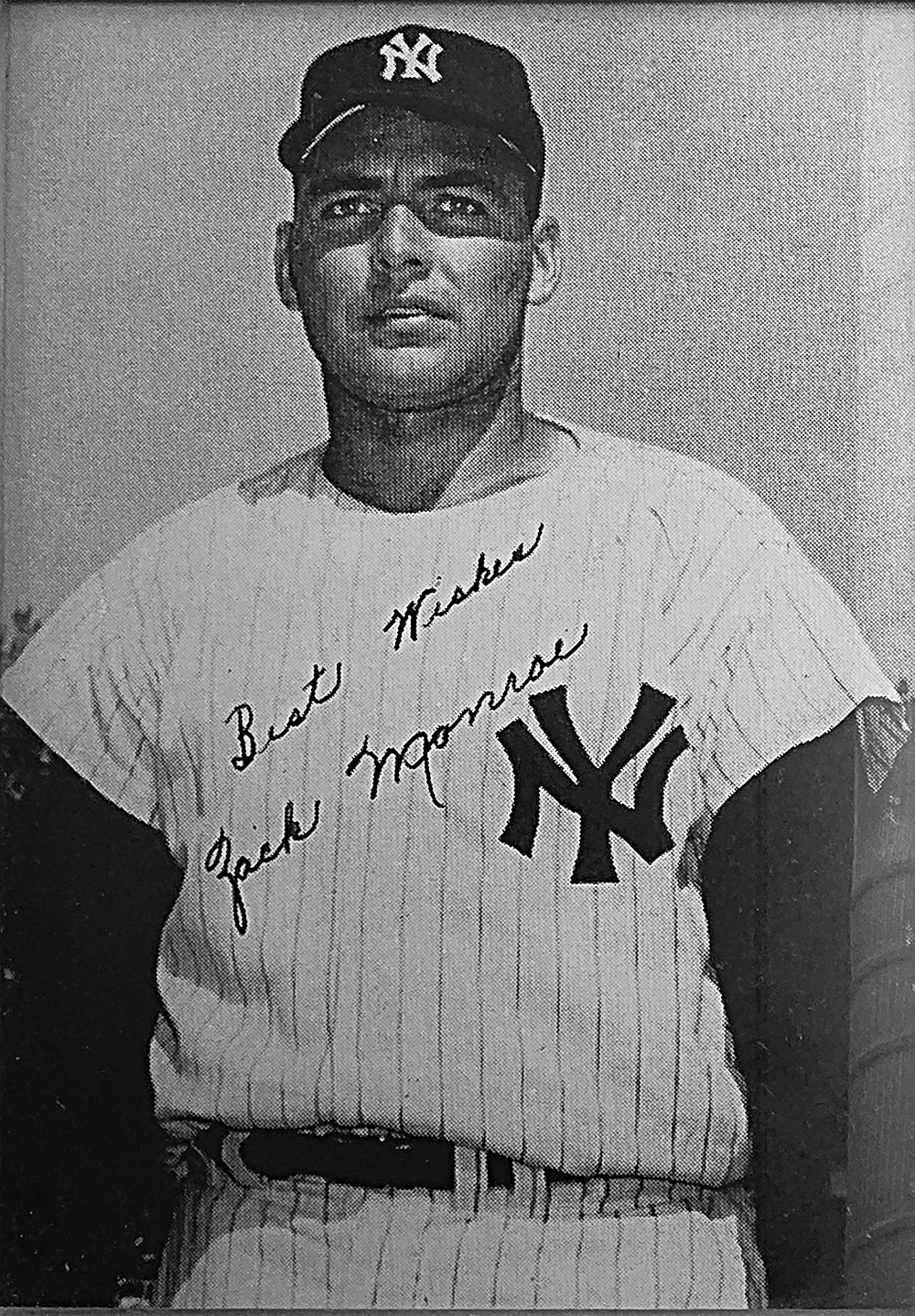
Zack Monroe, Roger’s brother, pitched for the New York Yankees when they won the World Series in 1958.
While attending Bradley, my brother’s pitching skill attracted the attention of a number of Major League scouts. As a Bradley Junior, Zack signed a professional contract for $25,000 offered by Lou Maguolo of the New York Yankees. With the signing, Zack’s career as a college pitcher ended. He was quickly assigned to the New York farm team in Quincy, winning seven games and losing six.
His next assignment was with the U.S. Army. After basic training, Zack was chosen for specialized winter training at Fort Hale, Col., where he trained for skiing and mountain climbing. While in the service, a semi-professional baseball club offered him weekend opportunities to pitch for pay, supplementing his U.S. Army earnings.
After two years in the Army, Zack returned to professional baseball, playing at Binghamton, N.Y.; Richmond, Va.; and Denver, where he compiled a record of 10 wins and two losses in 1958. That’s when the Yankees called him up to the Major Leagues. His roommate on road games was Yankee great Bob Turley. It was exciting to know Zack’s catcher was Yogi Berra and his pitching partners were guys like Whitey Ford and Don Larsen.
Though I was stationed with the American Forces Radio Network outside of Frankfurt, Germany, I was able to keep track of his performances. He ended 1958 with four wins and two losses, an ERA of 3.38 and a World Series ring after the Yankees defeated the Milwaukee Braves. Zack became the only Peorian to pitch in a World Series with a team that included Mickey Mantle, who later became a close friend of my brother.
Following discharge from the U.S. Army in November, 1958, I was able to see my brother pitch three shutout innings in spring training against the Dodgers in St. Petersburg, Fla. Zack made four relief appearances with the Yankees in 1959 before he was traded to Jersey City of the International League. He ended his professional career with the San Diego Padres — then of the Pacific Coast League. At one time during that season, Zack led the league with the lowest ERA. And while he never made it back to the big leagues, he did pitch and lose a game against the Havana Canes, 2-1. In the stands was Cuban Prime Minister Fidel Castro who asked to meet Zack after the game. Surrounded by some young heavily armed soldiers, Castro shook hands with Zack, congratulating him for pitching a good game. I’m not sure that was something to brag about, but I did.
His baseball achievements are remarkable, but so were the qualities of his life. He was a good Christian who accepted Jesus Christ as his Savior. I never heard him swear or brag or demean another person. He worked for more than 35 years for the same employer, Johnson Hydraulic of Bartonville. He was founder and president of the Bartonville Kiwanis Club. Whenever he needed a speaker, he asked his little brother. He was a wonderful husband and father for his wife, Barbara, and their four daughters, Tonya, Lynette, Monica and Keri. All four did so much for Zack in his final days to make sure all of his needs were met with loving care. They were truly God’s Angels of Mercy. Our two sisters, Judy and Carol, join me in thanking them and their families for all they did.
My wife, Nancy, died in November, 2018, and Zack’s wife in 2019. We then found time to take walks together almost daily around the lagoon in Pekin and to have breakfast every week at Bob Evans in East Peoria. I thank God for the opportunity I had to bond with my brother as visits to his Bartonville home in the last two years became more precious and meaningful as his health declined. It has not been easy talking to him in his hospital bed with only an occasional facial response.
I was never able to beat Zack in a single game or sports contest whether it was playing “H-O-R-S-E” or “21” in basketball or ping pong. He beat me at everything including going to Heaven, but I take great joy that he was my brother and my hero.
QUOTE OF THE MONTH: “The hardest part isn’t losing you. It is learning to live without you.”