
The latest book I’m reading is titled “Mourner’s Bench” by Sanderia Faye. Set in a rural Arkansas town in the 1960s during the Civil Rights Movement, the story is told through the eyes of an 8-year-old African American girl, Sarah Jones, who is trying to navigate her spiritual beliefs against the backdrop of impending social change, the traditional norms of her community, and the inevitability that some will be reluctant to change — even when the change may benefit them most.

DANIEL MCCLOUD
As Civil Rights workers descended on the town, promising voter equality and improved education, tensions rose not only among White residents, which, given that period of time, was expected. However, what was not expected was the tension and pushback from Black residents, many of whom had become satisfied with their place at the bottom of the hierarchical status quo of inequality, partly out of fear of daring to want more. One could imagine that after years of overt oppression, including physical harm, any peace was welcomed, regardless of the sacrifice.
Benchmark
The conundrum was likely present in many rural communities in the South that found themselves at the intersection of the Jim Crow era and the Civil Rights Movement. When weighing the costs of the increased freedoms that improved education and voting power would bring against the fear of violence that often accompanied them, I imagine the answer was not as black-and-white or as clearly defined as the railroad tracks that have long separated Black and White communities even to this day. In this particular instance, the message to the Civil Rights workers was simple: “We live here; you’re just visiting.”
Throughout this ordeal, the Black church and one young girl’s desire for salvation became the catalyst. In many Southern communities, including the rural community of Miccosukee, Fla., where I was raised, there were spiritual revivals. Typically, these were two-week periods during which young “sinners” would sit in the front of the church on a literal bench called the “Mourner’s Bench.” Against this backdrop of one of the most traditional practices in southern Black communities, the church, which has historically been at the forefront of social justice movements, Sarah and the rest of the community began to question what all of this meant. The church setting was particularly significant, since the pastor did not welcome the Civil Rights workers.
‘Educated’ votes
One of the main priorities of the Civil Rights workers who journeyed to the South during that period was addressing inequalities in the local education system and registering Black voters. This case was no different. When Sarah attended a makeshift alternative school for Black children, created by Civil Rights workers to teach Black students their history and focus on empowerment, questions arose (“Even the genius asks questions,” rapped Tupac Shakur in “Me Against the Word”). During her first visit to the school, Sarah was introduced to the importance and power of voting.
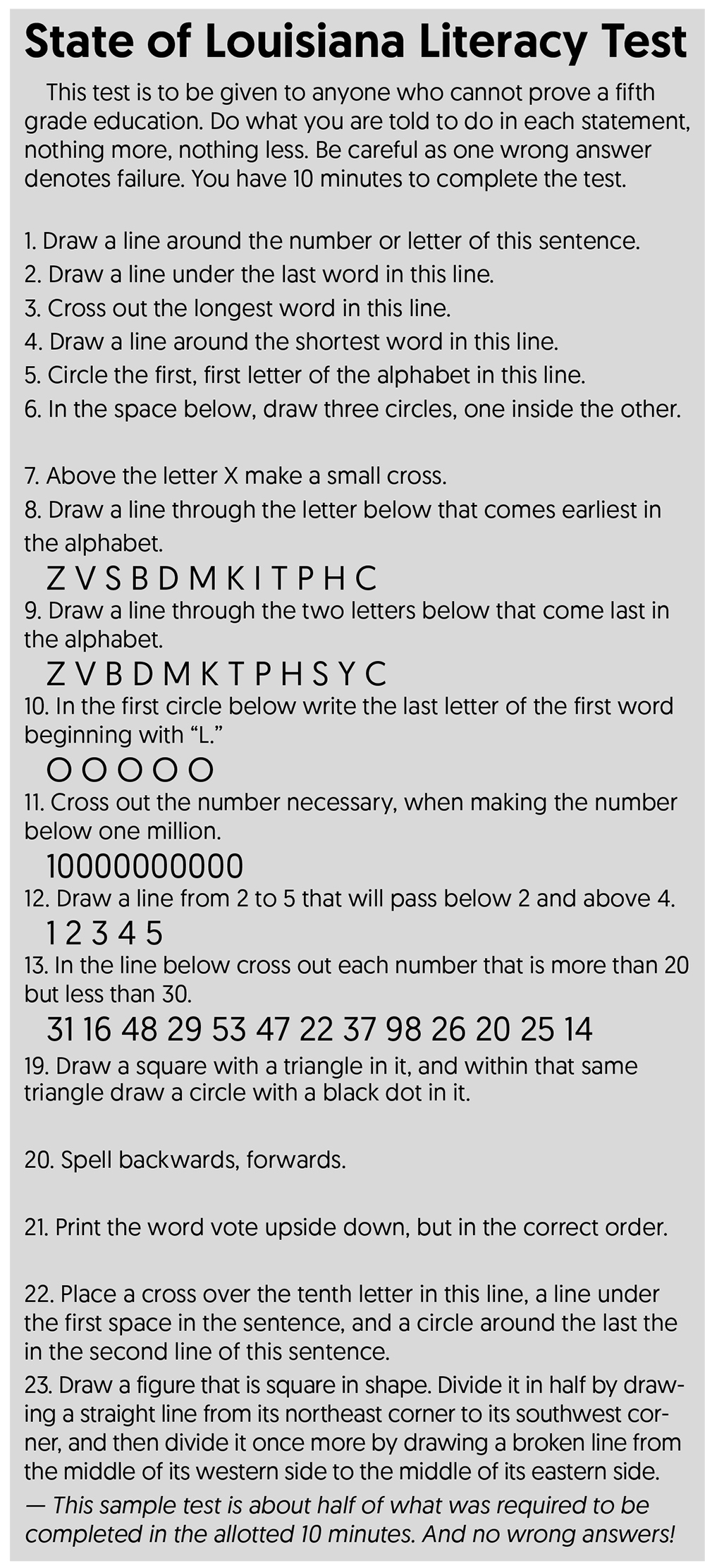
That brings us to the reason for my article. To illustrate, one of the best ways to learn and become informed is to read and ask questions (Even a genius asks questions). Because she was a very intelligent girl, her teachers asked her to help with voter registration for adults in the community by teaching them how to fill out the forms. They gave her a copy of an Application for Registration Questionnaire and Oaths, along with a “Literacy Test.” Because she was intelligent, she asked questions about the literacy tests. Her instructors educated her, and I will use the premise of that conversation to highlight a history of voter suppression in this country.
Those familiar with the Jim Crow South will recognize the “Literacy Test,” poll taxes, constitutional tests, and the ever-present threat of violence and death, all of which were used to suppress the Black vote.
Under the poll tax, Black voters seeking to register had to pay a fee. Those who could not afford the poll taxes were not allowed to register to vote and were therefore excluded from the electoral process. According to a New York Times article titled “Politics and the Poll Tax,” published on May 19, 1965, poll taxes were used to suppress the Black vote as late as 1964 in states such as Mississippi, Alabama, Arkansas, Texas, and Virginia.
Conspiracy
Literacy tests were used to prevent Black voters from voting by requiring them to answer questions or read passages to prove their ability to read and comprehend. One might think this wouldn’t be a big deal, but the ability of Black people to obtain a quality education has been an uphill battle since the era of enslavement, when Black people were forbidden to read. The struggle for quality education continued even after the Brown v. Board of Education of Topeka decision, 347 U.S. 483 (1954).
Records show that at the Mississippi State Convention in 1890, legislators amended their constitution to include literacy tests and poll taxes for eligible voters. The amendment required all eligible voters to read portions of the Mississippi Constitution and to comprehend any section. Ironically, many eligible, poor, White voters could not pass these literacy tests. As a result, many states enacted the “Grandfather Clause” (Yes, this is the origin of the phrase. Remember, even the genius asks questions.) The Grandfather Clause allowed individuals who had been able to vote before the literacy tests were created to continue voting without fear of voter suppression.
The remainder of the book details how Sarah and others in the community would come to realize that some change is worth the risks, if not for us, then for those who will come after us. They realized the stakes were simply too high.
Fast-forward to 2026, and the stakes remain high. The news cycle is flooded with bills, laws, and initiatives related to voting. With the 2026 midterms approaching on Nov. 3, staying informed is critical. We must all think for ourselves and act accordingly, balancing our decisions with whatever sets our moral compass, whether that is faith or something else. Recognizing that not just faith but also action will be required. We cannot take it for granted that everything will be okay. History has a way of repeating itself. Remember, even the genius asks questions.
We cannot remain complacent. Vote!!