
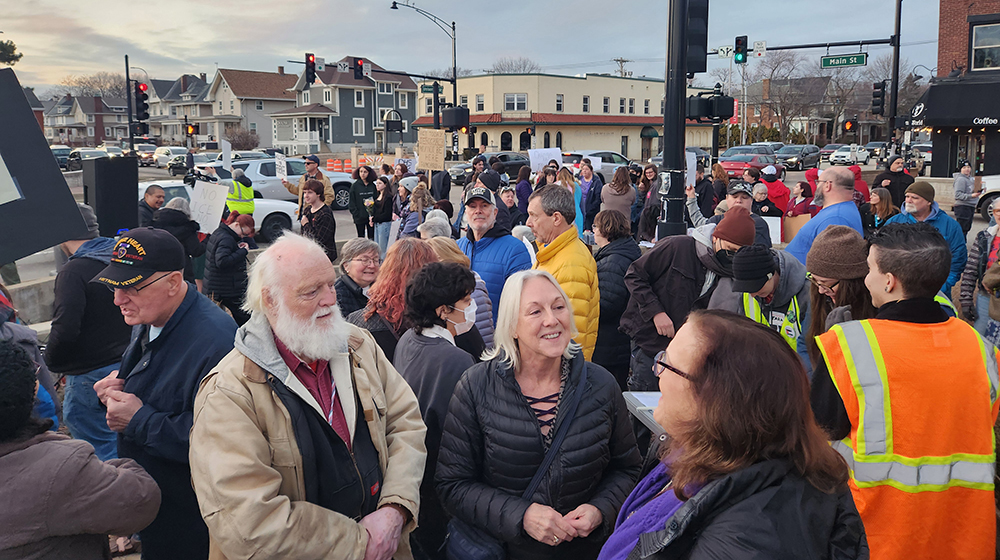
Demonstrators gathered at Main and University on Jan. 9 for a candlelight vigil for Renee Good, who was shot dead by an ICE agent in Minneapolis.
KANDAS MERRIAM
Large groups of people have been gathering throughout the community on almost a weekly basis anymore to protest the United States government and reconstruct the heart of a working-class America.
Brutal immigration enforcement and Venezuelan invasion have been the latest causes of chaos that saw the corner of Main and University become a hot spot to face the cold reality of this administration (health care, funding cuts, unaffordability, oligarchy and war have inspired plenty of protests throughout 2025).
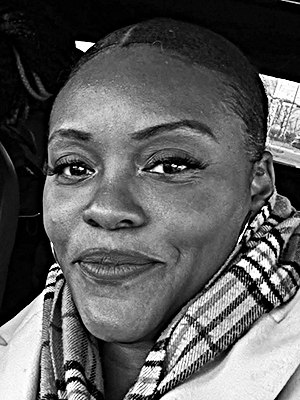
CHAMA ST. LOUIS-BOONE
“This is what democracy looks like,” local organizer Chama St. Louis-Boone has called to plenty a crowd as she leads the way to — hopefully — better days around here. “This is what democracy looks like!” they call back. “This is what unity looks like … This is what unity looks like!”
Almost 300 principled souls braved the frigid cold on Jan. 19 and almost as many cruised in their cars in a perennial parade up John Gwynn Drive from the Civic Center to Grace Baptist Church to celebrate MLK Day.
The People’s March — Honoring Martin Luther King’s Dream took refuge in the confines on Richard Pryor Place, and the warm embrace of peace and prosperity packed the church’s pews.
And things started to heat up when Rev. Mansa Edwards kicked off the ceremony with the question, “Where do we go from here, community or chaos? Whether we continue in chaos or achieve community depends on our culture.”
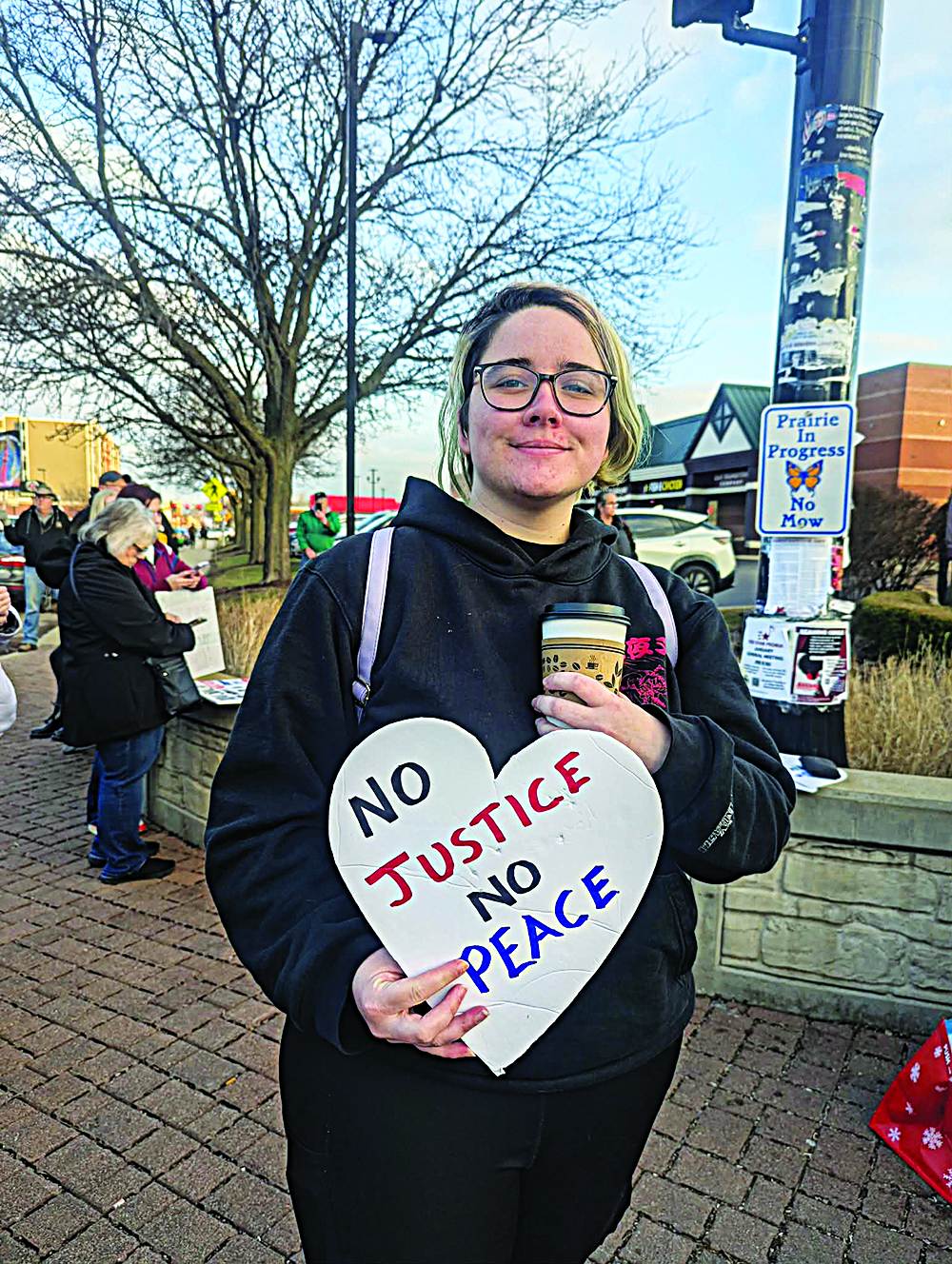
Candlelight vigil at corner of Main and University.
KANDAS MERRIAM
Communal culture
The chaotic nature of these times was why Vincent Migeotte came from Germantown Hills despite the icy temperatures. “So much is going on these days,” he said, “We want to be a voice for peace.”
Whatever you think about what’s going on in this country and the government’s craze for a new gilded age, it’s hardly been peaceful.
Maybe a thousand held a candlelight vigil throughout the night of Jan. 9 for Renee Good on the corner at Campus Town. The 37-year-old mother of three was shot to death by ICE officer Jonathan Ross on the streets of Minneapolis, which has been the epicenter of America’s chaos after ICE agents and National Guardsmen stirred things up in Los Angeles and Chicago last year.
ICE agents killed another legal observer in Minneapolis, Alex Pretti, on Jan. 24.
“We should be deeply concerned,” Rev. Jennifer Innis told the candlelight vigilantes at Main and University, “especially for minorities. For as long as people think that brown people are a problem — and that’s been a long, long time — we all have a problem.”
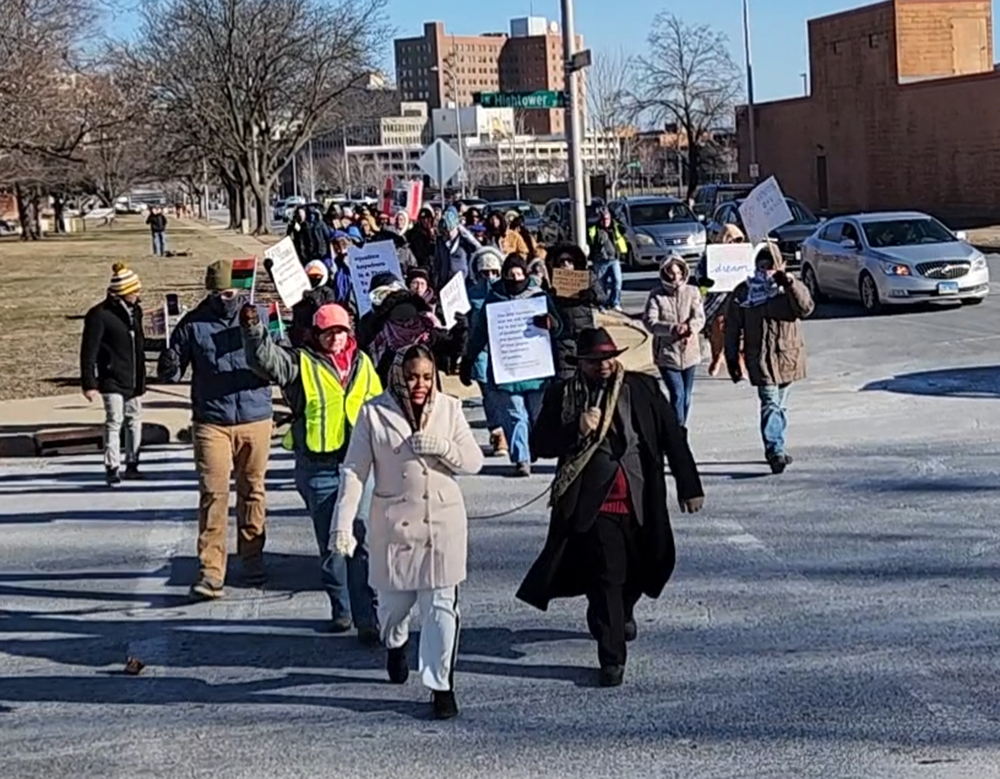
Chama St. Louis-Boone, left, and Rev. Mansa Edwards lead the People’s March on Jan. 19 in Downtown Peoria. BRIAN LUDWIG
Back at Grace Baptist, Rev. Edwards pondered the politics of today: “When we first heard the slogan ‘Make America Great Again’,” he pondered to the congregation, “I thought about when — if ever — was the golden era for Black people in America?
“I would say it was the Reconstruction era immediately following the Civil War. During that time we built Black Wall Streets, we created and erected HBCU’s all across the nation and elected more Black people in office than at any other time in America.”
Facts of the matter
Dr. Larry Ivory, president of the Black Chamber of Commerce, took the mic and laid out the facts that minority businesses face 160 years later: Today, only 1.35 percent of government contracts go to Black businesses and only 1.8 go to Hispanic ones, according to the Office of Management and Budget. White males eat up about 95 percent of the contract pie.
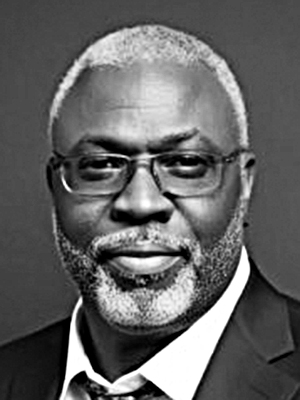
LARRY IVORY
Ivory said Peoria has an approximately 25 percent Black population, but it has only three percent of city contracts. There’s a similar discrepancy in school contracts as well.
“There is absolutely no discrimination when it comes to collecting taxes,” Ivory said. “So why should there be discrimination when it comes to getting contracts?
“To make this ideal of a more perfect union,” he continued, “we have to challenge it to be better by taking a look at equity and inclusion — affirmative action. Those things are bad words on Capitol Hill right now. But we must never quit, never deny ourselves an opportunity — all of you leaders — to push for an agenda of economic equality.
“King was moving to an agenda of economic reciprocity.”
On a day dedicated to King, the speakers were inspiring like the civil rights leader.
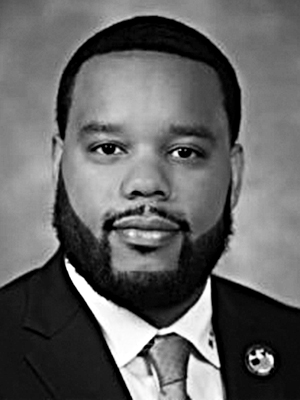
ANDRE ALLEN
Peoria County Diversity, Equity & Inclusion Director and Peoria City Councilman Andre Allen talked about a trip to Montgomery, Ala., where some 400,000 slaves were sold at auction during a dark period in U.S. history.
“Here I am, a free Black man, an elected official staying at a great hotel — just weeping with privilege — and I felt it and started bawling because I knew about the people who came before me. I knew I was three generations away of being sold on that slave dock.
“I am the direct beneficiary of diversity, equity, inclusion, belonging, accessibility and social justice. … It benefits the entire human race.”
Cutting through the chaos
Allen vowed to continue to fight for justice. That’s something Elner Clark has been doing for 60-some years. Her brother, the late Mark Clark, founded the Black Panthers of Peoria and was shot dead by Chicago police in 1969 in a raid to kill Fred Hampton. She followed Peoria Public Schools President Gregory Wilson at the dais.
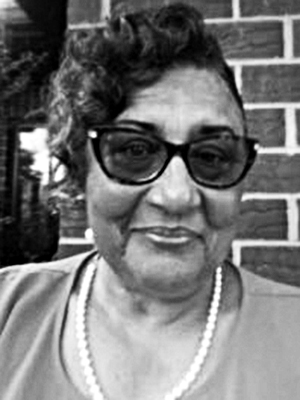
ELNER CLARK
“At this point in time that is so pivotal, I stand before you with tears in my eyes,” she said as she marveled at the series of successful gentlemen who had just spoke. “I was a student at Manual High School in 1964 when the Civil Rights Act was passed and the next year the Voting Rights Act was passed. … At that time there was not one Black custodian, there was not one cafeteria worker, there was not one counselor, not one nurse, not one professional in all of District 150 — no Black teachers, none of that presence was in District 150. And look how far we have come. We’ve come a long way.”
But then Clark went off script when she addressed the question of the day: “I was prepared to talk about ‘Where do we go from here, chaos or community?’ That’s deep because Dr. Martin Luther King 60 years ago proposed a question and it is upon our doorstep right now in 2026: Where are we going to go with this chaotic situation we have in America?
“I was going to stick to the book — say something nice and clean … And then I looked at the news and I saw a 72-year-old man whose home had been raided who was taken out nearly naked with nothing on but socks on his feet, underwear and a blanket,” she exclaimed. “Looks like chaos to me!”
Where do we go from here, chaos or community? Clark said chaos is confusion, disorganization, and community is the sense of brotherhood, sisterhood and love. She perpetuated what MLK preached in the face of the massive resistance to the Civil Rights Movement that has been knocked several steps back lately.
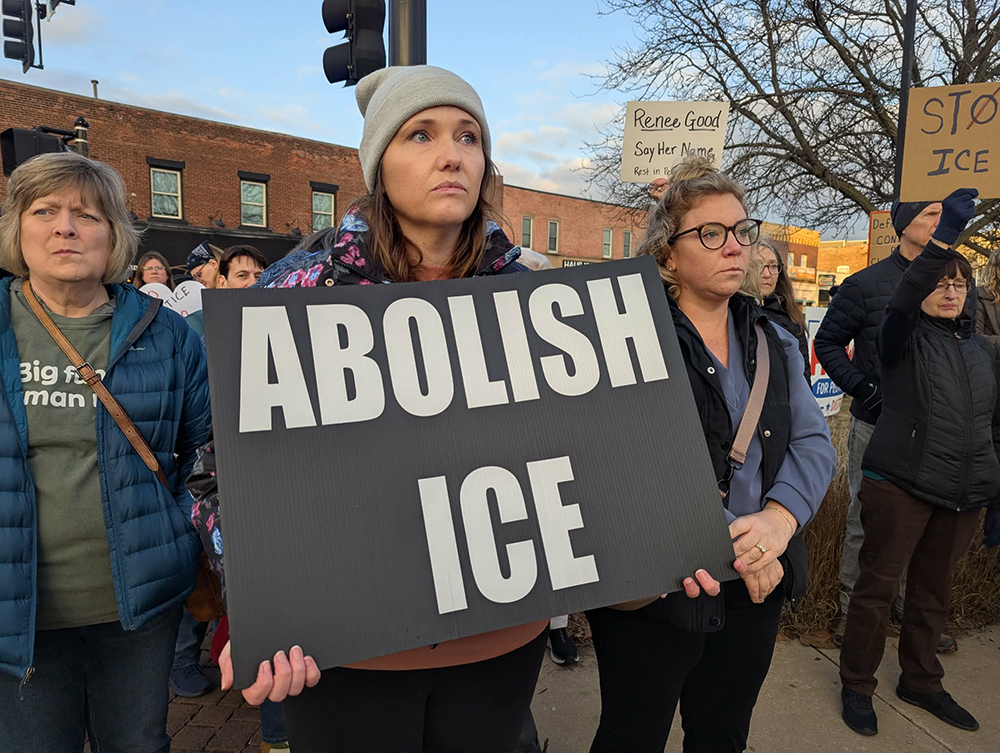
Demonstrators gathered at Main and University on Jan. 9 for a candlelight vigil for Renee Good, who was shot dead by an ICE agent in Minneapolis.
KANDAS MERRIAM
The inherent theme throughout all these gatherings — Hands Off, No Kings — is coming together for a greater cause, something bigger than ourselves. The rising tides lift all boats thing. Equity leads to equality.
“We all came on different ships, but we’re all in the same boat,” PPS president Wilson said.
Keynote speaker St. Louis-Boone encapsulates the effervescence that is essential to bringing so many people and organizations together. She believes. She’ll make you believe, too. “When the pendulum swings as it always does,” she told the candlelight vigil. “We must be ready and act with love for one another.”
Social change takes more than words. It takes action, which turns into policy, which can lead to better outcomes.
Together.
Jack from Peoria summed it up perfectly at the MLK service with the words of Civil Rights icon Fanny Lou Hamer, “No one’s free until everyone’s free.”
— Brian Ludwig is Managing Editor of The Community Word