
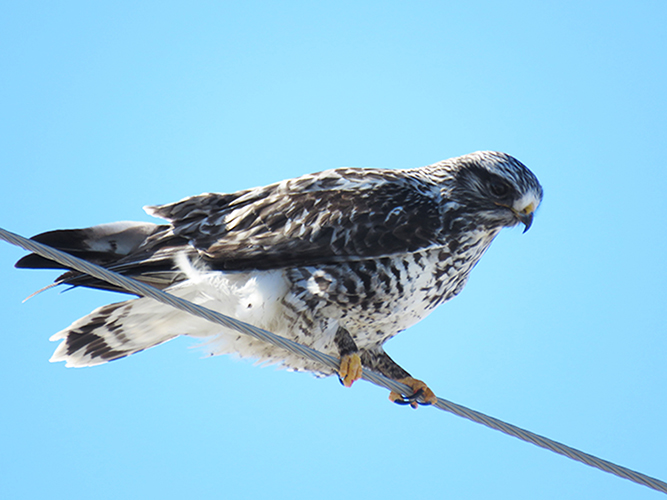
A Rough-legged Hawk surveys the open fields. Note the namesake feathered legs down to the toes.
PETE FENNER/PEORIA AUDUBON SOCIETY
By December, central Illinois has fully embraced its winter wardrobe. Trees stand stark with their dark branches etched across the low, cold sky. Prairie grasses stand rigid bending to a north wind. It is also the time of year for the Christmas Bird Count. Each December, I find myself driving the backroads searching for birds in a stark landscape. Scanning the fields and hedgerows, I am looking for a winter visitor that has become a personal indicator of a successful winter count: the Rough-legged Hawk. They return each year from the Arctic, slipping southward just as the landscape here begins to resemble the open, treeless places they left behind.

MIKE MILLER
Red-tailed Hawks are easy to spot — year-round residents waiting on familiar utility poles. But the Rough-legged hawk is different. It carries the tundra with it. Its wings seem longer, its flight lighter, its colors a study in winter camouflage: mottled browns and creams, a broad dark band across the belly, and those feathered legs that give the species its name. Even perched, it looks built for cold, wrapped in a thickness of plumage that defies December winds.
I turn onto a gravel road that cuts between two long fields left in stubble. It’s the kind of place rough-legs favor, where voles tunnel amongst the matted grass and the open space offers no surprises. I have been here many times in other winters, waiting for that distinctive shape to rise into view. Today, I am prepared for a long search, but before I even stop the engine, I see a hawk hovering motionless above the ground, wings beating just enough to hold its position. Only rough-legs hover like that, kiting in place as they listen for the faint rustle of prey.
I watch as the bird drifts sideways, then rebalances itself in the air. Its hunting style has a kind of patience I never tire of. These hawks have spent their breeding season in a world of near-constant daylight, raising chicks on cliff edges and feeding on lemmings in winds that could peel skin.
Here, in the comparatively mild Midwest, they seem almost at ease, though the work is the same: read the land, trust the air, instinctively do the quiet calculus of survival.
After several minutes, the hawk folds its wings and drops like a thrown stone. It vanishes behind a rise, then lifts again — empty-taloned but unhurried. The light is fading, the sun dragging a cold copper edge along the horizon. The rough-leg circles once above me, its pale underside catching the last thin beam of daylight, before gliding toward the far field where the grasses lean under the wind.
I watch until it becomes a speck, indistinguishable from a distant clod of soil. December often feels bare, emptied of motion and sound. But the rough-legged hawk reminds me that winter is not a vacancy — it is an arrival. On these quiet afternoons, the prairie is full of travelers, each one carrying a story of where they’ve been and the long miles still ahead.