
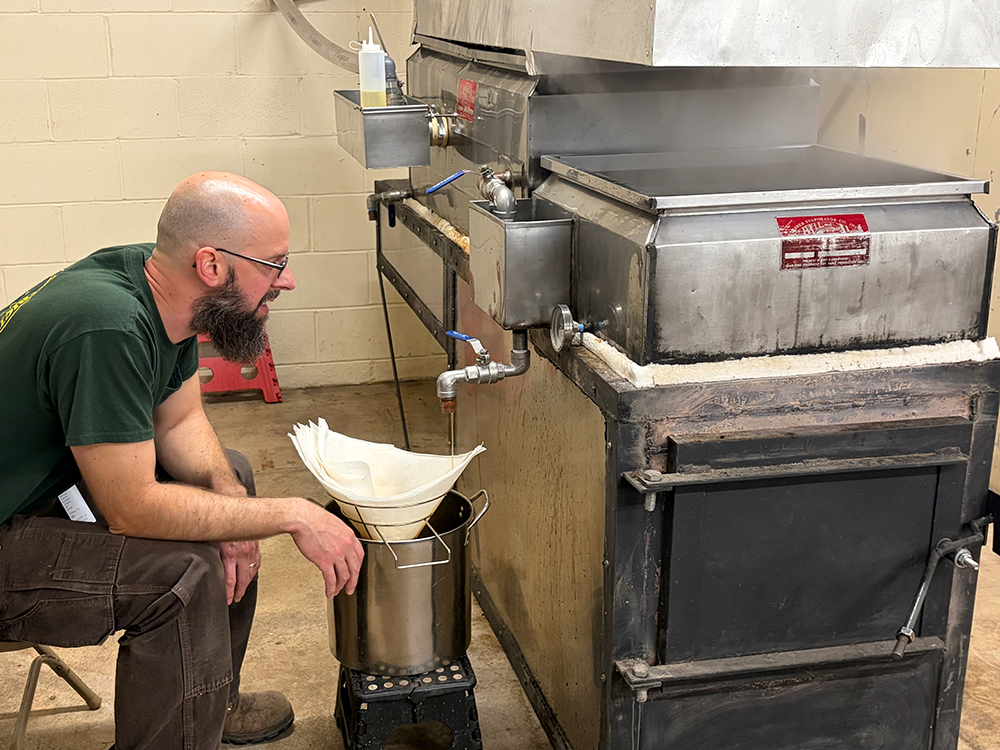
Jacob Mol keeps watch at the evaporator thermometer during a recent sap boil at Camp Wokanda. MIKE MILLER
The coming of spring and the greening of the forests is a magical time. As plants begin to grow from warming soil and leaves bud out on trees, a certain wizardry awakens within green plants. We all learned in grade school that green plants can use sunlight to produce food for themselves in a process called photosynthesis. For most of us, it is a rather ambiguous idea. To maple syrup makers, it is not abstract, it is practical. They transform photosynthesis into a palette-pleasing, culinary delight.

MIKE MILLER
For more than a decade, Jacob Mol at the Peoria Park District’s Camp Wokanda has been producing maple syrup utilizing the abundance of sugar maple trees that grow on a north-facing slope in the park. It started as an educational program with a dozen or so trees tapped into buckets that were emptied daily into pans atop a barrel stove. After hours of boiling, enough water vapor is driven off to concentrate the sugar into a syrup. It’s a time-consuming process that takes 40 gallons of sap to make one gallon of syrup. The educational programs were a hit, and everyone left the programs wanting to take home their own Wokanda maple syrup.
The magical draw of maple syrup is a year in the making. Trees that are tapped in late February are dependent on the success of the tree to create sugar from sunlight the prior growing season. Sugars and starches, the building blocks of trees, are produced throughout the growing season. As fall approaches, and the blaze of color graces the canopies, trees will begin to retreat into dormancy. They flush their sugars towards their root systems. Here, below ground, the sugars will wait through the colder months. In March, the sugar laden sap will begin to flow from the roots back towards the branches as daytime temperatures get above freezing. If night temperatures go below freezing, that sap will retreat down to the roots. This ebb and flow is what Mol depends on when collecting sap. This is the moment when the sunlight from the previous summer is available to him.
Mol has refined and expanded the syrup operation at Camp Wokanda. More than 200 taps feed sap through flexible tubing. Collection lines and holding tanks have replaced the buckets. Instead of relying solely on wood fires to evaporate water, he now uses reverse osmosis filtering to remove around 2/3 of the water. The remaining water is evaporated through wood fire and a purposely designed evaporator pan. Production has increased to more than 4,000 gallons of sap collection, producing around 100 gallons of syrup per season. Mol has taught so many people about the process of maple syrup he finds himself narrating every move of his workday.
Jacob Mol’s Maple Syrup is available at Camp Wokanda and at Forest Park Nature Center’s Trailhead Nature Store. If syrup isn’t your cup of tea, Wokanda has collaborated with John S. Rhodell Brewery in Downtown Peoria, where the brewmaster has created a Wokanda Maple Wheat using maple sap instead of the normal water in the brewing process. It’s finished with maple syrup to give it a unique hint of maple. The Maple Wheat goes on tap Wednesday, April 22 in celebration of Earth Day. Later in the year, Rhodell will release a Wokanda Breakfast Stout.
Few foods illustrate the wonder of photosynthesis so beautifully. Maple syrup is not merely a sweetener; it is a story of energy moving through nature. It reminds us that every forest is quietly harvesting sunlight, storing summer within its trunks, and waiting patiently for the moment when that hidden light can flow again.
To see a video of the process of Maple Syrup production at Camp Wokanda, visit: