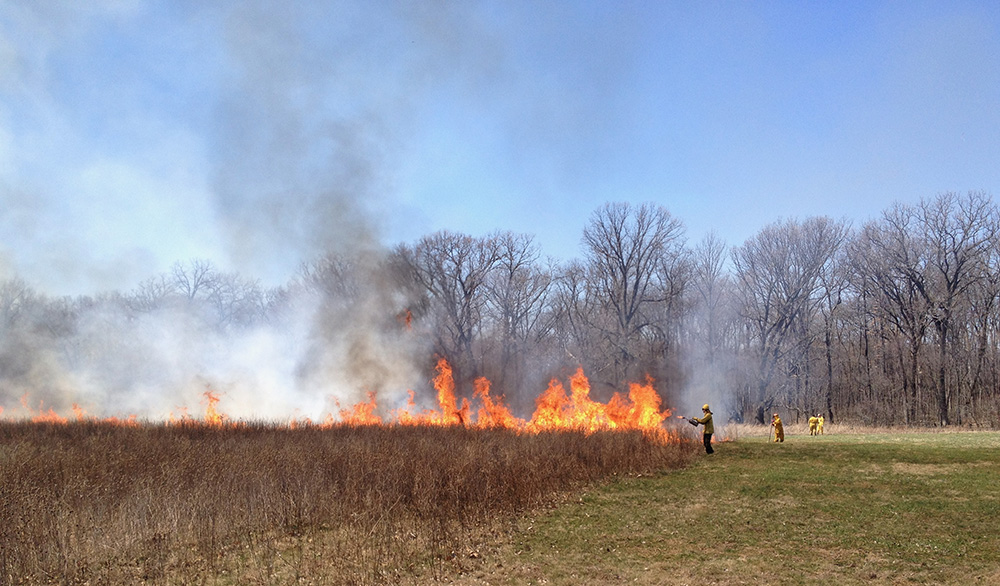
Fire purposely being reintroduced to a prairie at Tawny Oaks Field Station in Peoria County.
MIKE MILLER

MIKE MILLER
November’s cold nights are often contrasted with warm, sunny days. By the time we turn the calendar page beyond October, we have experienced our first killing frost. The growing season has ended, and long hours of daylight retreat toward a darkening winter. Basking in the sun on a warm November day is a special treat. As a kid growing up in the Midwest, I remember my dad calling these periods of late-season warmth “Indian Summer.” I had always thought it was an odd term. Even he didn’t know why the late-season warm spells were attributed to Indigenous Americans. Perhaps it has a lot to do with the annual publication of John T. McCutcheon’s “Injun Summer” cartoon, which first appeared in the Chicago Tribune in 1912. Its accompanying narrative was full of old stereotypes about Indigenous culture. While many look back fondly on these comforting tropes of history, the truth is much more meaningful.
Since the last ice age, the Midwest climate has experienced late-season periods when warm Pacific air masses extend eastward. These fleeting days of warmth come after the first killing frost. For more than 10,000 years, the weather pattern has played out across the landscape, shaping habitats and ecosystems over time. During this span, Indigenous Americans also inhabited the same landscape. Human beings adapted their culture to thrive within the realities of the prairies and forests of the Midwest. One of those realities is that the landscape could become quite flammable during these late-season warm spells.
Summer weather
In 2021, a research paper by William McClain et al. was published in the Natural Areas Journal. It documented close to 800 historical references to wildfires in the Midwest from 1673 to 1905. The research showed that a vast majority of those fires were human-caused and occurred during the late growing season, coinciding with what historically has been referred to as “Indian Summer.” The challenge of historical research is that it fundamentally focuses on written records. Indigenous history is based on oral traditions, which are much more difficult to cite. While Indigenous Americans have long had an oral history of using fire on the landscape, modern culture has had few methods of quantifying the ancient stories passed on to descendants. However, clues remain on the landscape, and modern tree detectives (dendrochronologists) have begun to unlock their secrets.
In October, The New Yorker published an article by M. R. O’Connor titled “How Tree Rings Challenged the Myth of American Wilderness.” In it, the author describes how scientists have documented fire scars in ancient tree stumps to piece together thousands of years’ worth of fire history in the eastern United States. It gives credence to the oral histories of Indigenous Americans’ use of fire to maintain the landscape. Fire used by humans for thousands of years not only influenced the land; it created habitats that evolved to become dependent on fire for survival. The “wilderness” our immigrant ancestors first experienced had always been influenced by humans. When the people who had stewarded that land for eons were removed, those habitats suffered.
Wise tales
Many are realizing that there is great wisdom in Indigenous Knowledge. Ecologists are working closely with tribal nations to integrate ancient knowledge into modern science. In March 2025, Gov. JB Pritzker signed legislation authorizing the Illinois Department of Natural Resources to return around 1,500 acres of land, including Lake Shabbona State Park, to the Prairie Band Potawatomi Nation. Raphael J. Wahwassuck is a tribal council member and a descendant of Chief Shab-eh-ney. He has been instrumental in developing a plan to steward this land. Part of that care involves returning fire to the landscape. Wahwassuck said, “The things that we’ve known for millennia, that were suppressed through the suppression and genocide of our people are now all trends. Now burning is a trend, but our people have been doing it for generations. It’s nice when Western science catches up with Indigenous science.”
This new era of collaboration between ancient and modern perspectives gives me hope that our future will hold a more meaningful ecological perspective. We often use the term “prescribed burn” to describe the modern practice of returning fire to the landscape. This term was developed to describe how we use fire like a “prescription” to treat a disease. We know that fire is crucial for maintaining the health of our ecosystem. Without it, oak forests cannot reproduce, and prairies will not survive. Indigenous Americans are calling their reintroduction of fire to the landscape “Cultural Burning.” Fire is a means for them to reestablish Traditional Ecological Knowledge back to the land. It is a forward-looking perspective. … A new way of describing the healing without dwelling on the disease. It’s time to put away the “Injun Summer” cartoon and redraw our vision of a new tomorrow — one where ancient knowledge and modern science thrive together.