
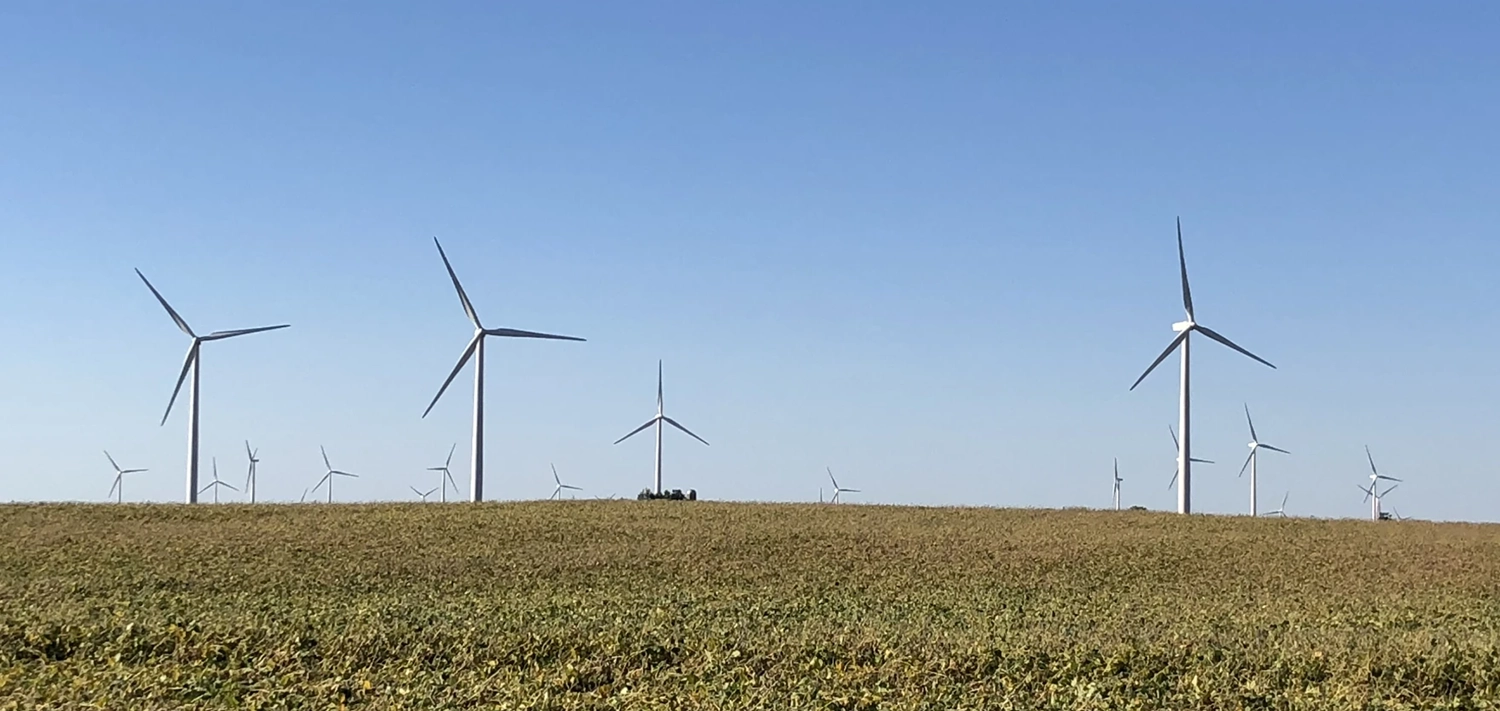
JOE DEACON/WCBU
EDITOR’S NOTE: The project was approved by the County Board after presstime on Nov. 5. The Community Word will have a followup story in the December issue out Nov. 25.
After two weeks of evidence and testimony capped by a day-long session, Peoria County’s Zoning Board of Appeals on Oct. 14 voted to recommend denying the application for a $1.5 billion wind farm proposed by Four Creeks, LLC.
At the Holiday Inn at Grand Prairie, applause mixed with mumbled concerns about jobs, landowners who’d agreed to host turbines, schools hoping for new revenue, and everyone’s electrical grid. The vote was not a final decision.
Afterward, project developer Carson Robers told The Community Word, “We appreciate all the time and effort from the county and public, pro and con, that participated in this process. Now, the County Board has the ultimate decision.”
The 4-2 votes to not recommend the application as it exists came from Rob Culp, Greg Happ, Tom Modlin and Steven Pollack; voting to recommend approval were Richard Burns and Stephen Schmitt.
‘Fairness objection’
Opposing voices cited possible negative effects on property values, noise, and the speculation that 113 turbines would discourage development.

Rich Porter
The ZBA also voted to suggest conditions for approval, which will go to the County Land Use Committee, whose meeting hadn’t been scheduled as of press time, and then the County Board at its Nov. 5 meeting.
In the process for about four years, Four Creeks’ proposal is to build 113 turbines in about 27,113 acres on 453 parcels in Brimfield, Jubilee, Millbrook and Princeville townships. If the County Board OKs it, the $1.5 billion project could be online in 2029, generating about 500 megawatts (MW) of energy, the equivalent of powering more than 160,000 homes annually.
Representing more than 30 people opposed to the project, Attorney Rich Porter delayed the morning’s closing statements with a “fundamental fairness objection” including complaints that ZBA member LaVonne Sammis was absent due to a previously scheduled trip, that video coverage had been spotty, and that daily transcripts were sometimes unavailable.
Four Creeks speaks
Four Creeks’ attorney Seth Uphoff eventually started his summary of the company’s case, saying affected roads would be upgraded, “shadow flicker” would be minimal, wildlife and aviation largely unaffected and communications disruption “almost zero”; plus that Four Creeks would, at the building-permit stage, provide 100% financial security for future decommissioning. He also said that the wind farm would create 688 construction jobs lasting about two years and 97 permanent jobs; add $30.6 million in total county tax revenues over the life of the operation; and add $307 million in local taxes for all tax bodies, “especially schools.”
Four Creeks has estimated that the wind farm will give school districts in Brimfield, Princeville, Stark County and Williamsfield together more than $190 million over its 40-year operation, or an average of about $5 million annually. Uphoff said 150 property owners have agreed to have turbines on their land, and though terms are confidential, historically such deals provide between $8,000 and $33,000 a year, according to a 2024 report from the U.S. Department of Agriculture’s Economic Research Service.
As far as sound and property values concerns, Uphoff said the project meets state requirements on noise and setbacks, and Four Creeks also pledged to do additional sound studies during permitting and conduct a confirmation report during construction, and that the experience nationally and at Illinois’ 4,000-some wind farms, there is “no consistent negative impacts” on nearby parcels’ property values, appraisers have said.
Appealing to county officials, Uphoff said, “You set the goalposts. Don’t move the goalposts.”
Robers had two general observations about the 15 days of testimony.
“It was a very condensed process [with] a lot of consecutive days back-to-back,” he said. “And as for the deliberations themselves, I believe there was procedural confusion by members — and opponents, too — about what they were voting on, in several votes. [For example,] there was a 6-0 vote that [Four Creeks] did meet the hearing factors.”
In fact, attorney Andy Keyt, representing Peoria County, reminded the board that they’d also determined Four Creeks did meet the county’s sound requirements.