
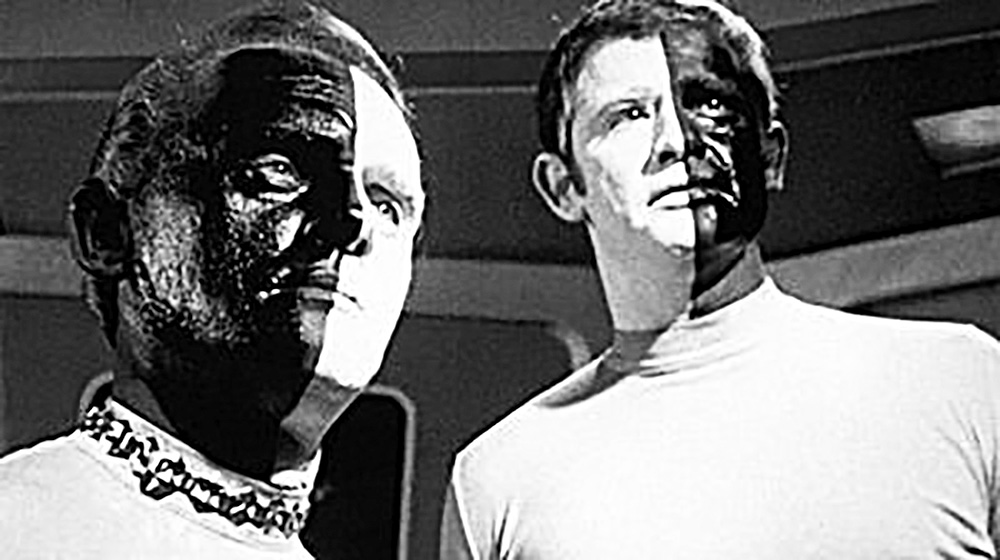
Star Trek villains Commander Bele (left) and Lokai.
“Space: The final frontier. These are the voyages of the starship Enterprise. Its five-year mission: To explore strange new worlds, to seek out new life and new civilizations, to boldly go where no man has gone before!”
This was the opening narration of the original Star Trek, featuring Kirk, Spock, Uhura, and the rest of the crew of the starship Enterprise. Every Saturday around 4 p.m., I heard those words and was transported far beyond my childhood reality.

DANIEL MCCLOUD
At the time, I didn’t recognize how groundbreaking the show was, especially in terms of racial diversity, gender equity, and more. Years later, I recognized the powerful social commentary woven into many of the episodes’ themes.
I believe inclusivity and social justice are central themes for Gene Roddenberry, the show’s creator. Created in 1966, during the height of the Civil Rights Movement, the show’s themes remain relevant, particularly amid the current culture wars in this country. Culture wars are defined as the struggle to define a country’s values across the intersection of race, religion, gender, political affiliation, economics, and sexual orientation.
These wars are waged daily on social media and in the 24-hour news cycle. The toxicity in these spaces is palpable and evokes the darkest chapters of American history, past and present. Unsurprisingly, race and ethnicity are the most common ammunition in the culture wars. In studying this, I recalled a particular episode of Star Trek: The Original Series, Season 3, Episode 15, titled “Let That Be Your Last Battlefield,” which aired on Jan. 10, 1969.
The plot centers on two alien beings from the same race on the same planet who find themselves on the Enterprise: Lokai, a fugitive with a black face on the left and a white face on the right, and Commander Bele, the oppressor, who is tracking Lokai and has a white face on the left and a black face on the right. Their distinct physical differences only highlight the chasm between them, despite how similar they are.
In this episode, Commander Bele is portrayed as superior, and Lokai as subordinate or oppressed. Imagine, for a moment, that these beings were not from a planet in a far-off galaxy but from the third planet from the Sun in our solar system. What follows is the dialogue from a tense scene between Commander Bele and Lokai, in which it is clear that deep hatred and resentment run between them, rooted in a shared history of violence and oppression. Now imagine that this was a conversation between Whites and Blacks in America.
Lokai (Black Americans): They raided our homes, tore us from our families, herded us like cattle, then sold us into slavery.
Commander Bele (White Americans): They were savages. We took them into our homes. We educated them.
Lokai (Black Americans): Yes, just enough education to serve the master race.
Commander Bele (White Americans): You were the product of our love, and you repaid us with murder.
Lokai (Black Americans): Why should a slave show mercy to the enslaver?
Commander Bele (White Americans): Slaves? That was changed thousands of years ago. You were freed. Freed!
Lokai (Black Americans): Were we free to be men? Free to be husbands and fathers? Free to live our lives in equality and dignity?
Commander Bele (White Americans): You were free if you knew how to use freedom. You were free enough to slaughter and burn.
Lokai (Black Americans): To you, we are a loathsome breed. Genocide of my people is your utopia!
Commander Bele (White Americans): You are insane, filthy little plotter of ruin.
Lokai (Black Americans): You … vicious subverter of every decent thought.
Does this dialogue sound familiar? Each day, the same battle (arguments) plays out across social media and the 24-hour news cycle. The historically oppressed vs. the historic oppressor, fighting for America’s identity by promoting individual identity. We all come from different places and are probably more alike than different, like the antagonists Lokai and Commander Bele. However, we can never underestimate the influence of the places we come from and the lenses and realities that shape us.
In the absence of genuine dialogue, it’s easier to insult and demean. There’s a saying that people use curse words because they lack the vocabulary to express themselves. The culture wars exemplify this theory. From the average American to the highest offices in the land, poisonous hate speech is spreading and seeking to destroy, with no one benefiting.
And what of the children? How easily are they indoctrinated into this poisonous environment, and is technology the new front line? Ultimately, the cycle of hate and the culture wars will persist. But at what point will the culture wars devolve into a literal physical war? Not-so-subtle rumors of another Civil War have circulated.
But back to Star Trek. Ultimately, the two beings were returned to their home planet, where they discovered that after centuries of fighting, both races had destroyed each other. The years of bitter hatred had culminated in uncontrollable violence and rage. Some say death brings freedom. If we keep going this way, yes, someday we’ll all be free. Or we can course-correct and choose understanding over indifference, empathy over hate, and peace over war. If not, perhaps the culture wars will indeed be our last battlefield.