
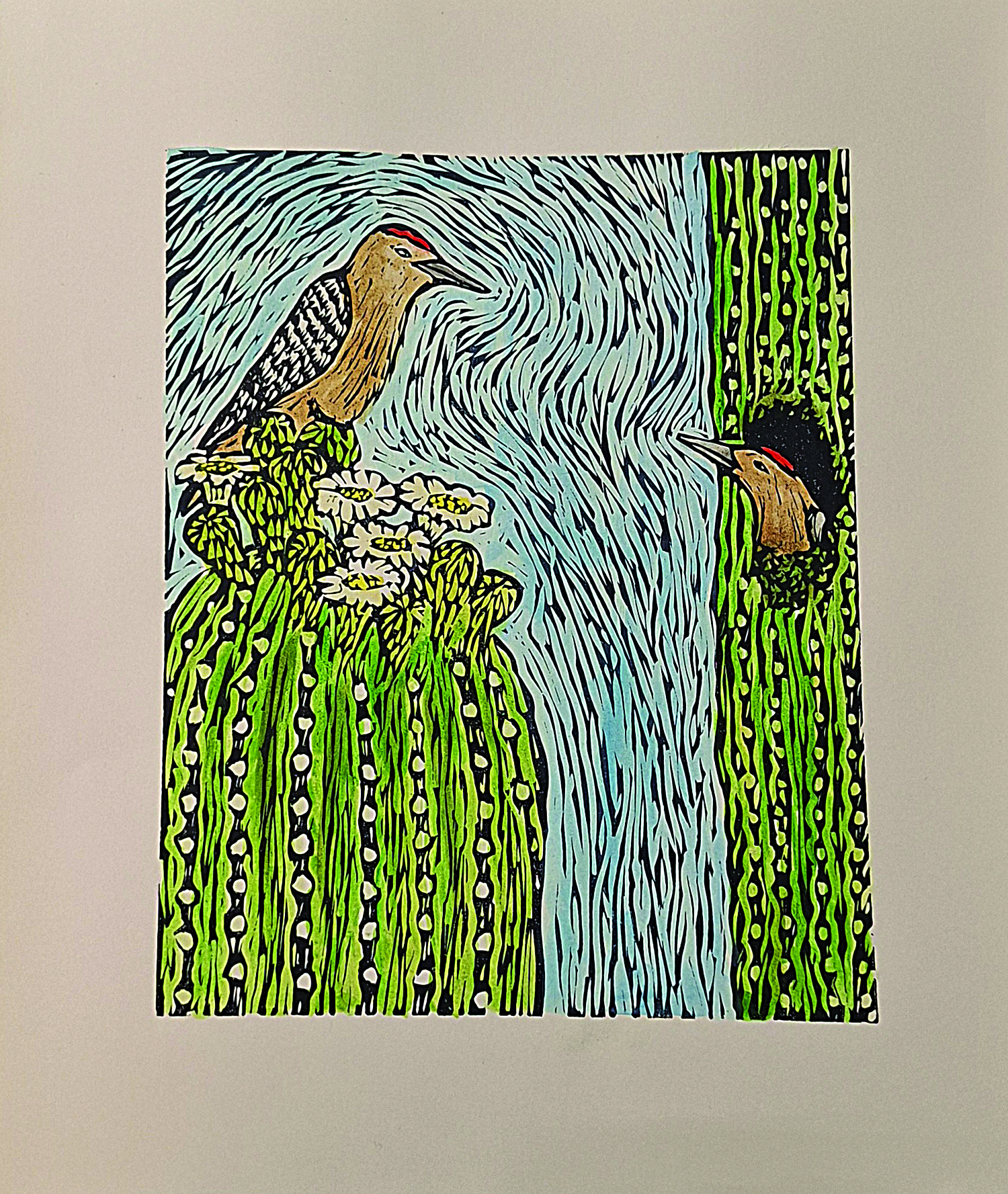
Angela Risinger created this colorful print that reveals intricate texture.
The Peoria Art Guild is pleased to present “ImPRESSIVE Surface ImPRESSions” a collaborative exhibition of relief printmaking by Cathie Crawford, Patricia Whalen Keck, and Angela Risinger that runs through Nov. 28.
Printmaking, with its rich history and diverse techniques, has captivated artists and art enthusiasts for centuries. This fascination with relief printmaking — an art form characterized by its unique approach to image making. From the bold lines of linocut to the intricate details of woodcut, relief printmaking offers an artistic expression that has historical influence on art history.

JOHN HEINTZMAN
Linocutting is a printmaking technique defined by its materiality. “Lino” is derived from “linoleum” a medium from which the image is carved. The carving is done with special gouging tools which create lines of various textures and widths.
The raised, uncarved areas of the lino give the artist the printable surface, while the carved areas remain ink-free — hence the category of relief printing. The “reliefs” create the artist’s image.
Ink is applied to the uncarved areas with a roller, known as a brayer, and then transferred onto the paper either by hand or by a printing press. The relief print can have multiple layers added or be left as a single monochrome print.
Linocuts have been a very popular form of relief printing due to their accessibility. There are various printmaking methods within relief printing and often those involve more complex techniques to create the relief, such as woodcuts. Linoleum, however, is very soft and malleable, making it perfect for the printmaker to use. The process gives life to the matrix, with rich areas of color often contrasted by intricate lines.
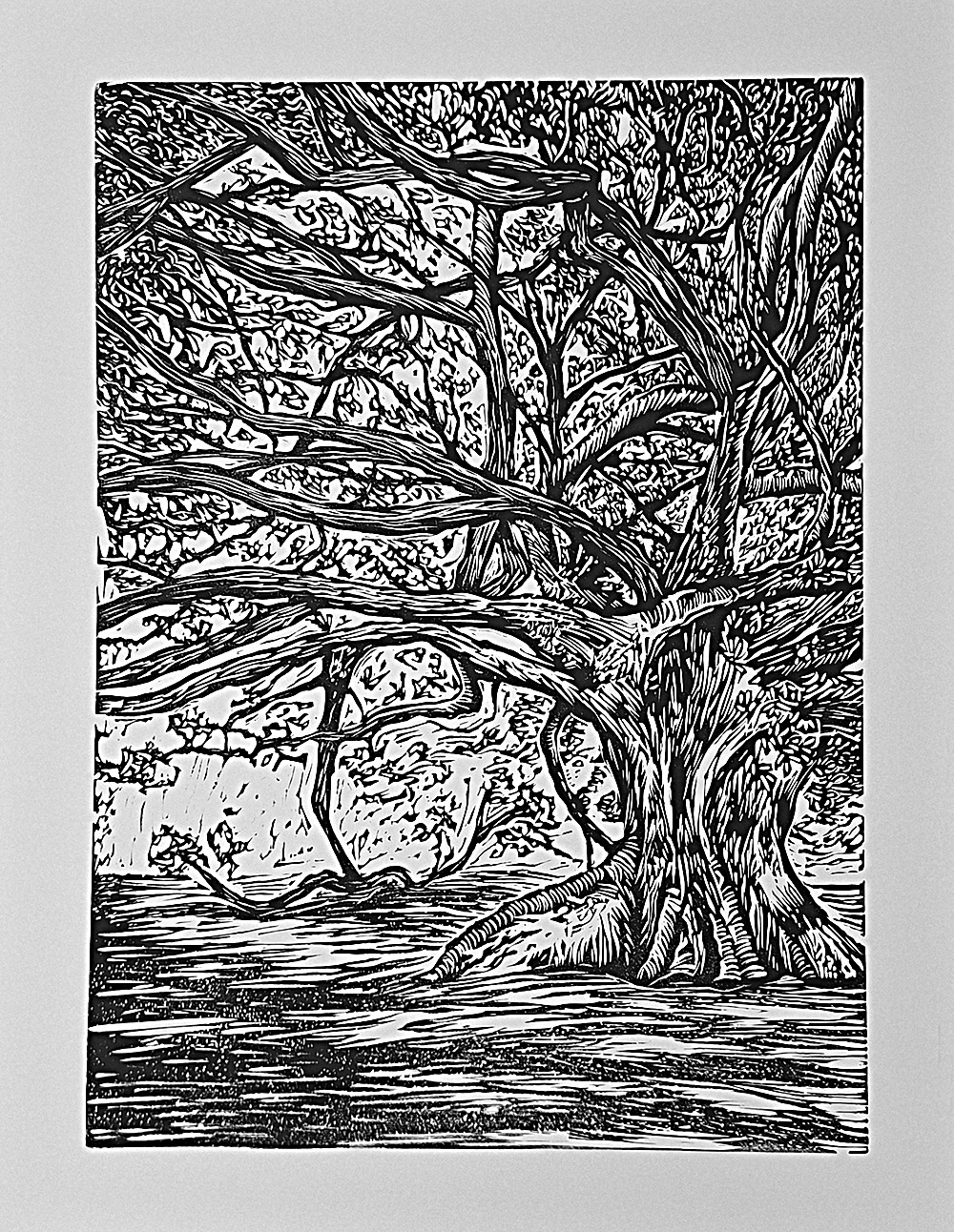
Look for prints like this one by Angela Risinger at the upcoming Bradley International Print and Drawing Exhibition this February and March.
SUBMITTED PHOTO
Linocut printmaking is part of modern art history compared to traditional relief printing methods like woodcut. Linoleum itself was invented in the 1860s as domestic and commercial flooring, but it wasn’t until the early 20th century that artists began using the material for printmaking. European avant-garde artists, particularly in Germany and Russia, started exploring the artistic possibilities of linocuts.
Angela Risinger’s prints are highly influenced by her love of all things natural. Her prints offer serenity, natural textures and motifs, and are realized as landscapes or creatures, especially birds. To Risinger, printing isn’t just an art form. It is a deeply meditative way to pause, observe, and connect with the beautiful details of the natural world.
Patricia Whalen Keck takes a thoughtful approach to creating her art. Whether it’s a bronze sculpture or a delicate drawing or a curious print, she presents a story that is personal yet accessible. Like Risinger, she is keenly aware of the human spirit and the often-overlooked creatures. Her organic-inspired linocuts were conceived by personal observation of a garden slug. It’s slow and meandering path gave way to delicate detailed shapes.
Keck’s interest in color began with a dedicated exploration of patinas for her bronze sculptures. Once introduced to linocuts, she saw specific colors and began personally mixing ink to achieve that hue rather than employing commercially produced inks.

Cathie Crawford created this incredibly colorful print.
SUBMITTED PHOTO
Woodcuts, on the other hand, are bold, brusque and striking images with natural and stylized lines reflecting a more rebellious spirit. Initially they were black and white with flat tonal gradations and a focus on negative space. The images have graphic elements and often appear two-dimensional. The wood grain gives these prints a natural texture like no other carving surface can.
Cathie Crawford has focused and mastered the reduction woodcut. Her matrix (cutting block) allows each layer its own identity as it is reduced through subtraction. Her work matured as she added stencils and color rolls to enrich her images. Her reduction woodcuts respect the nature of their materials: wood, paper, and ink. When combined, she brings her inspirations to life.
Crawford developed her style as she revealed the direct hand of their maker. Her works are dominated by intense colors, simplified shapes, and details derived from nature. Crawford’s understanding of the reductive means gives each print its own presence through her confident cuts. In reduction woodcuts there is a is a permanence that is irreversible, yet imbuing each print with a sense of certainty. Her landscapes beg us to enter and be part of her colorful

Patricia Whalen Keck.
world and to appreciate her unique perspective.
These three artists celebrate an art form that produces multiples — each unique with each pull from the press.
Crawford, Keck and Risinger will also be included in the 40th Bradley International Print and Drawing Exhibition in February and March 2027. This prestigious exhibit is a community event hosted by Bradley University, the Peoria Art Guild and the Peoria Riverfront Museum. Preeminent contemporary printmakers and draftsman from throughout the world were chosen by juror Sarah Smelser to celebrate the 40th Anniversary.
The Peoria Art Guild is open Tuesday through Friday 9am until 4:30pm and Saturday 9am until 2pm admission is FREE and open to the public.

unspecified