
Minutes after genetic genealogist Kaycee Connelly’s program at the Peoria Women’s Club last month, the midday sun warmed the polished hardwood floors and an air of genial activity filled the room as members rearranged tables and chairs.
 Activity and a pleasant resolve has permeated the storied organization over the last 140 years, and there’s more ahead, such as the public Zoom talk “Chautauqua’s Heart” Nov. 6 featuring author Mary Lee Talbot, plus members-only events diving into club archives and decorating for the holidays, and the long-term renovation of the red-brick building at Madison and Fayette downtown.
“Clara Parsons Bourland had moved to Paris [in the early 1880s] and came back to Peoria and said, ‘Peoria should have something like that’,” says Lynette Steger, First Vice President of the club. “We’ve never closed.”
Formed in 1886 — the year when Apache leader Geronimo surrendered, Chicago saw the Haymarket Massacre, the Statue of Liberty was dedicated, and 11 years before Bradley University opened — Bourland and 26 women had a founding mission, to secure the “educational, industrial and social advancement of women.”
By means of it promoting the arts, literature, music, politics, business and civic reform, the club has tried to serve the public and lead the community. The club did so in ways large and small, from issues such as mental health to working toward women’s right to vote, finally ratified in 1920. Along the way, the club was key to Peoria police hiring its first woman and preparing bandages for the Red Cross and kits for soldiers during World War I.
Many familiar area groups have roots with the Women’s Club, Steger says: the Peoria Art Guild, Peoria Players, the Civic Federation, Crittenton Center, Morton Civic Chorus and countless nonprofits. Julia Proctor White, the Women’s Club second president in 1924, helped start Peoria’s League of Women Voters.
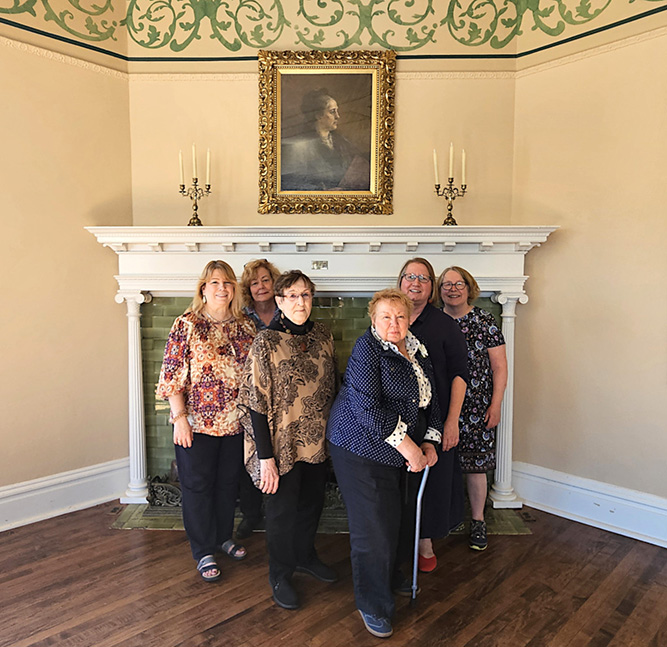
Peoria Women’s Club members pose in the parlor one October afternoon (left to right): Jennifer Wyeth, Connie Knoblauch, Becky Cummings, Maggie Nelson, Lynette Steger, and Donna Stanfill.
BILL KNIGHT
Now the nation’s second-oldest continuously occupied and operating women’s club, Peoria’s has changed, too. In the 1960s, it had some 500 members, and now there are about 100 — but that’s up 30% in the last decade. Various activities, civic work and classes continue.
“We draw on the past but try to keep relevant,” Steger says. “The club and what we do belongs to everybody.”
The Women’s Club’s efforts extend beyond metro Peoria. Currently, through a partnership with Café Santa Rosa in Peoria Heights, the club has coordinated sales of coffees grown in Colombia and now Ethiopia, Steger says, with proceeds helping to fund child care, free preventative-care clinics and sustainable income for women coffee-bean harvesters.
And for several years and into the future, the club has and will renovate the facility, opened in 1893. Already, the first-floor parlor, kitchen and dining area were remodeled, the decorative ceiling replicated to its original look, restrooms modernized, entrance ironwork restored, an ADA-compliant ramp built, a new roof and windows installed, and brick tuckpointing completed. Soon, with help from philanthropies and the community, members hope, the building’s wiring and water systems will be upgraded, and an elevator constructed to enable the second-floor theater (mostly unused since the 1970s) to be returned to the condition it was when it became the city’s first music and lecture hall.
“We’ve received a $500,000 donation,” Steger says., “and we plan to have a public challenge [to contribute].”