
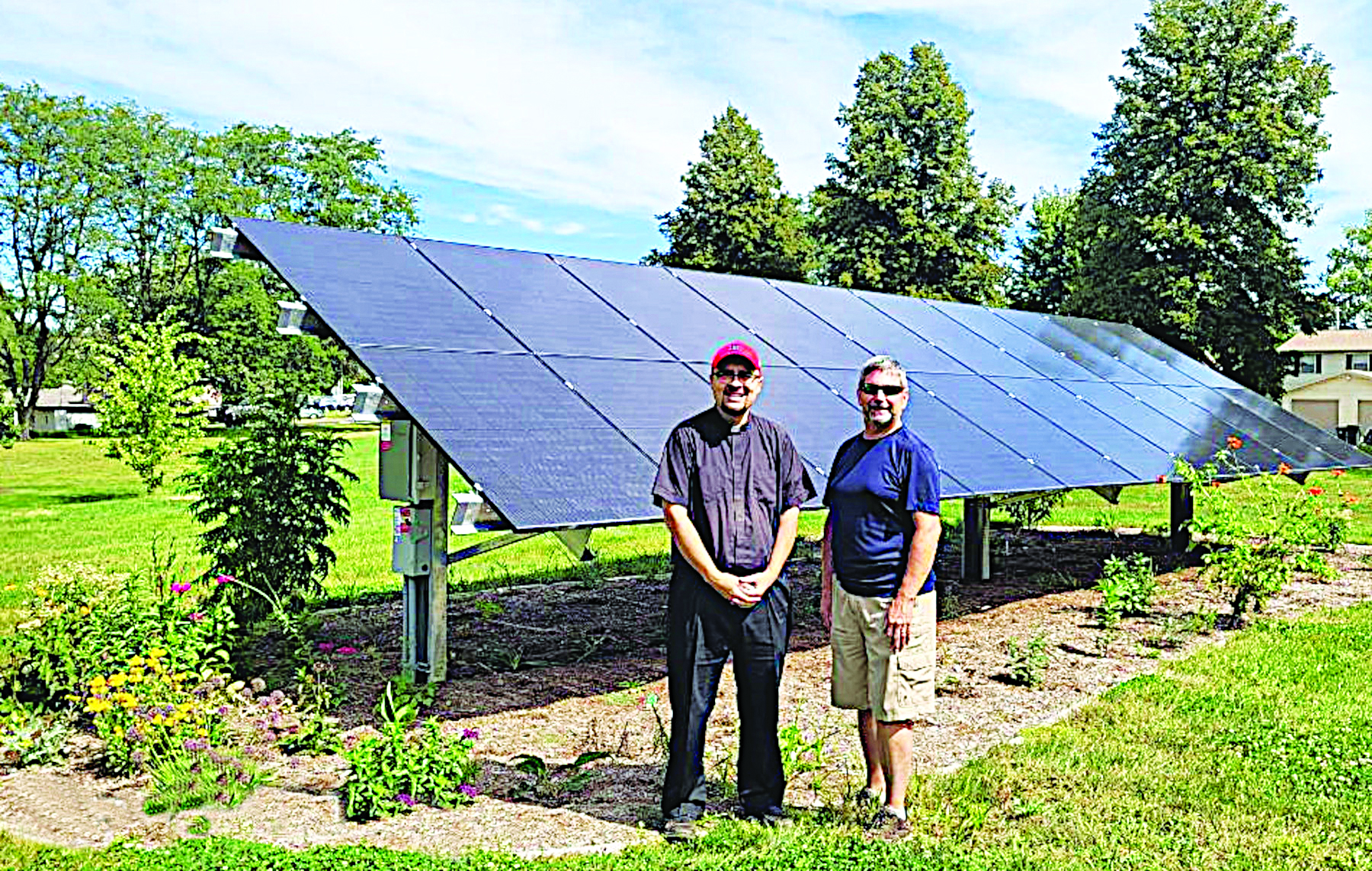
Father Jim Pankiewicz (left) poses in front of the solar panals that power St. Anthony’s Church campus in Bartonville with parishioner Lyle Fricke, who is a retired engineer and solar advocate and a key helper for the projects.
JOYCE BLUMENSHINE
Pope Francis issued his encyclical Laudato si’ more than 10 years ago, but the letter to all people of good will continues to have positive effects. At St. Anthony parish on Skyline Road in Bartonville, rows of ground-mount solar panels are in the process of getting Ameren approval to go live.
Released in 2015 — the year of the first world climate accord meeting held in Paris — Laudato si’ (“Praise be to you”), brought a profound call to the need for fast, world-wide action regarding global warming and environmental degradation. Subtitled “On Care for Our Common Home,” the landmark letter from the late pontiff frames the care for creation not merely as an environmental or political issue, but as a moral imperative. Francis called for all to care for our common home: Earth.
Father Jim Pankiewicz has been pastor at the parish just a few months, but he’s enthusiastic about St. Anthony’s “Care for Creation” volunteer efforts that embrace clean energy and pollinator flower beds. He’s completed documents for additional steps for new solar panels and the credits they will earn. Pankiewicz says he’s continuing the work initiated by his predecessor, Father Charles Klamut, who Pankiewicz credits for linking the message in Laudato si’ with advocacy and hands-on work at the church. (Klamut has a YouTube talk commenting that the pontiff’s letter “will serve as a warning that was heeded or not heeded as the world continues to veer towards a more unsustainable path.”)
Trial run
After St. Anthony member Lyle Fricke added solar panels to his house, he encouraged Klamut to consider the cost savings that solar energy could provide the parish in addition to following Francis’ teachings. Using his skills as an engineer, the Caterpillar retiree helped evaluate solar providers and guided the parish’s solar expansion along with committee efforts and input from the pews.
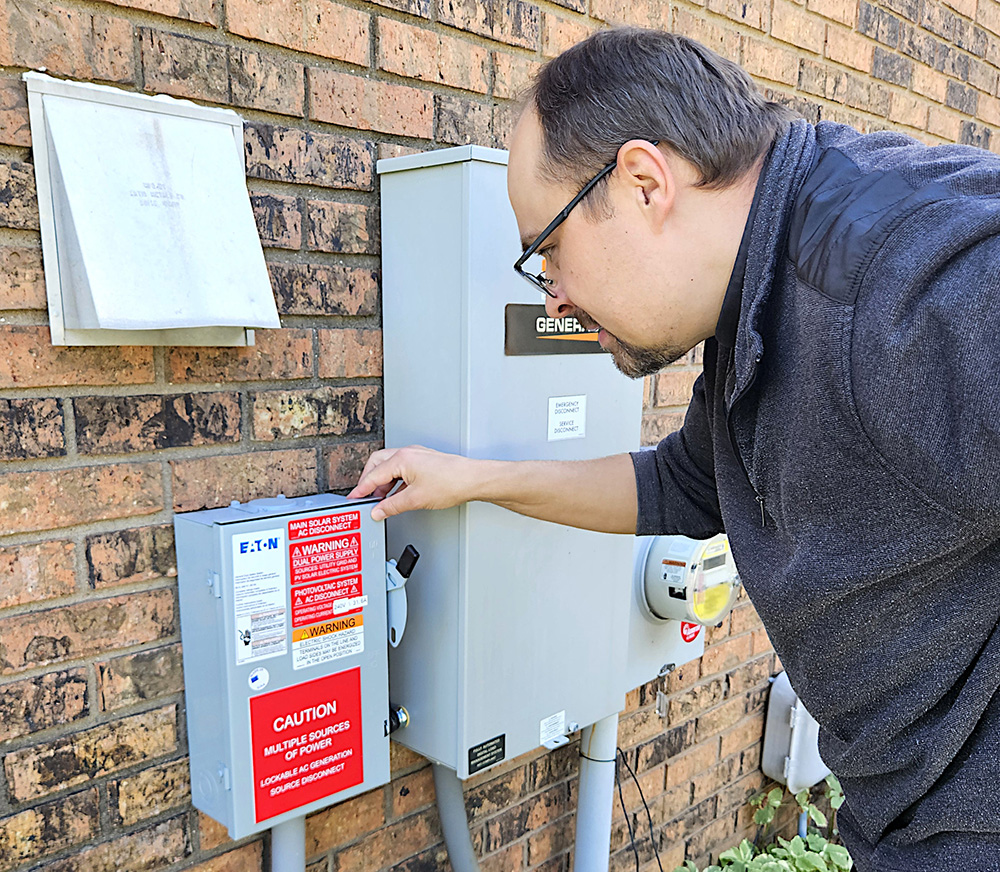
Father Jim Pankiewicz examines an exterior panel of St. Anthony’s new-and-growing solar system in Bartonville.
BILL KNIGHT
Fricke says the benefits have been proven in electricity cost savings. A major fundraising campaign, “Building Hope,” enabled the purchase of the first set of ground-mount panels, which were installed outside the rectory and office building. That 8.8-kilowatt system provides enough electricity to power those buildings and is estimated to save St. Anthony’s about $1,200 a year.
Now, a new, 79-kilowatt system will generate power for St. Anthony’s 10-acre campus’s church building and hall, and it’s expected to save the parish another $11,000 a year.
The church anticipates the whole system will pay for itself in seven years.
Communal approach
Also, St. Anthony’s subscribes to Community Solar, which enables people to get part of their energy needs from the sun. The energy comes from large, solar-panel installations that are basically solar farms collecting low-cost energy. The church sees Community Solar as an additional cost savings as it helps pay the Ameren fees, which are still billed even though their own solar is providing energy.
Information about Community Solar is available online from Illinois’ Citizens Utility Board (CUB) and other sources.
Besides financial benefits, change itself can be met with skepticism, but Pankiewicz credits parishioners for being open to change. Members benefit the environment as well as the church budget.
The church’s actions mean not relying on carbon-based fuels or releasing carbon dioxide that harm the planet. Updates in the church bulletin provide the congregation ample information and Parish Council meetings and other gatherings help keep members connected on climate-care work. Volunteers sign up each year to take care of different flower beds as part of the Care for Creation Committee.
“Cultivating a spiritual awareness of the environment is part of responsible stewardship to live with the awareness that all things are connected,” says Pankiewicz, who points to the book “Nature’s Best Hope: A New Approach to Conservation That Starts in Your Yard” by Douglas Tallamy, as a place to start with what can be done at home a step at a time.
Taking action for the environment is not extremist but responsible stewardship, Pankiewicz continues, and parishioners are continuing the work of Klamuth and Francis by heeding the call for climate care. They are embracing solar for more sustainable energy and adding plantings for conservation starting in their own church yard.