
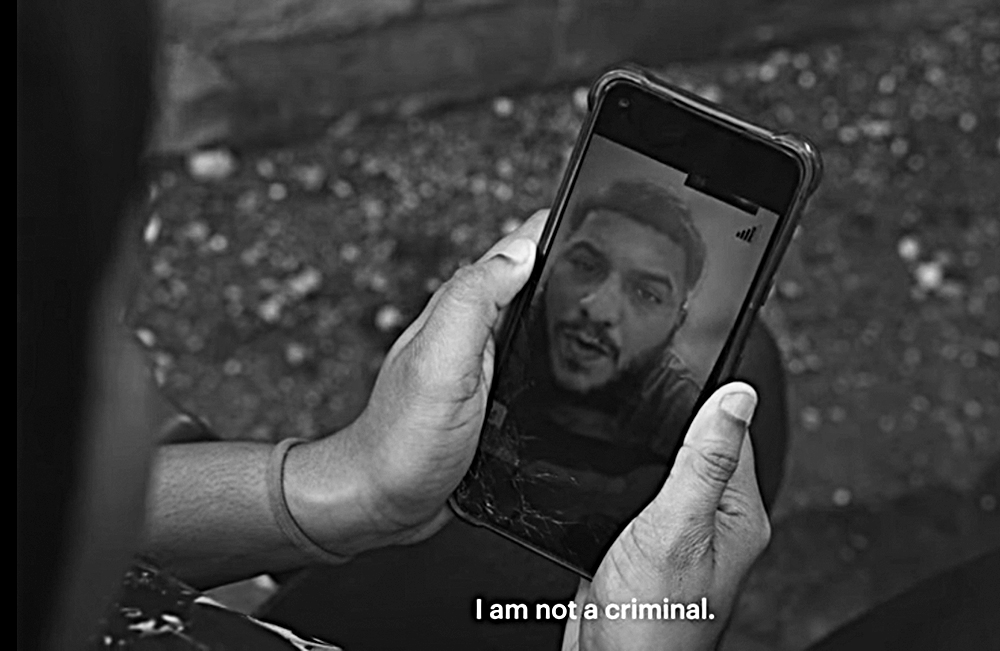
Roynerliz Rodríguez reviews the video she recorded of her husband, José Manuel Ramos Bastidas, before the U.S. government sent him to CECOT, a maximum-security prison in El Salvador.
SCREEN GRAB VIA PROBUBLICA.ORG
Published by PROPUBLICA
On Feb. 15, 2025, José Manuel Ramos Bastidas called his wife from inside a Texas immigration detention facility and asked her to record a message: “They detained me simply because of my tattoos. I am not a criminal.”
The Trump administration had sent dozens of Venezuelan immigrants to Guantanamo. He was afraid the same would happen to him. “Just in case something happens to me,” he concluded, “so you can be aware.”
Uncertain about his fate, Ramos wanted to make sure there was a record of what happened to him.
A month later, he was gone.
Investigation
This story was written in a collaboration with ProPublica, The Texas Tribune, and a team of Venezuelan journalists from Alianza Rebelde Investiga (Rebel Alliance Investigates), and Cazadores de Fake News (Fake News Hunters).
Denied & disappeared
Ramos never set foot in the U.S. — at least not as a free man. He left Venezuela in January 2024, hoping to earn enough money to pay for his newborn son’s medical needs. Born with a respiratory condition, the family’s “milagrito,” or “little miracle,” had severe asthma and repeatedly needed to be hospitalized. The cost of treatment had become impossible to manage on the meager wages Ramos made washing cars in Venezuela’s collapsed economy, so he trekked thousands of miles through a half dozen countries to reach the U.S. border.
When Ramos arrived, he didn’t sneak into the country. He followed the rules established by the Biden administration for immigrants seeking asylum. He signed up for an appointment through a government app and, when he was granted one, turned himself in to request protection. An immigration official and a judge determined he didn’t qualify, and Ramos didn’t fight the decision.
The government kept him in detention until he could be deported back to Venezuela.
In the months that followed, Donald Trump was elected president for a second term and began his mass deportation campaign. Among his first actions was to fly groups of Venezuelan immigrants whom he had labeled dangerous gang members to a U.S. military base at Guantanamo Bay, Cuba.
Ramos, 30, panicked and called his wife to say he was worried that the same was going to happen to him. On a video call his wife recorded, he held up a document he said was proof that immigration authorities had agreed to deport him to Venezuela. But he worried that they would not honor that promise.
“I have a family,” he said, staring directly into the camera. “I am simply a hard-working Venezuelan. I haven’t committed any crimes. I don’t have a criminal record in my country nor anywhere else.”
A month later, a more upbeat Ramos called again. He seemed confident that U.S. officials would send him home. Ramos’ family started preparing for his return.
The family never heard from him again.
A day after that call, Ramos and more than 230 other Venezuelan men were sent to the CECOT maximum-security prison in
El Salvador, one of the most notorious in the Western Hemisphere. Without publicly providing evidence, the administration accused each of them of being members of Tren de Aragua, the Venezuelan prison gang it designated a terrorist organization.
Criminal
In the months since the mass deportation — one of the most consequential in recent history — the Trump administration has released almost no details about the backgrounds of the people it deported, calling them “monsters,” “sick criminals” and the “worst of the worst.” Several news organizations have reported that most of the men did not have criminal records. The ProPublica investigation team went further, finding that the government’s own records showed that it knew the vast majority of the men had not been convicted of violent crimes in the U.S. We also searched records in South America and found that only a few had committed violent crimes abroad.
Now, a case-by-case examination of each of the deportees, along with interviews with their lawyers and family members, reveals another jarring reality: Most of the men were not hiding from federal authorities but were instead moving through the nation’s immigration system. They were either in the middle of their cases, which normally should have protected them from deportation, or they had already been ordered deported and should have first been given the option to be sent back to a country they chose.
Due process denied
Like Ramos, more than 50 of the men had used the government app called CBP One to make an appointment with border officials to try to enter the country. Others had crossed illegally and then surrendered to border agents, often the first step in seeking asylum in immigration court.
According to this analysis, almost half of the men were deported even though their cases hadn’t been decided yet. More than 60 of them had pending asylum claims, including several who were only days away from a hearing where a judge could have ruled on whether they would be allowed to stay. Judges or federal officials had issued deportation orders for about 100 of the men, and a handful had even agreed to pay their own way home. Others, like Ramos, had spent their entire time in the U.S. in detention. They had no opportunity to commit crimes in the U.S.
Meanwhile, many of those who were allowed into the country had been appearing at their court hearings and immigration check-ins. At least nine had been granted temporary protected status, which gives people from countries affected by disasters or other extraordinary conditions permission to live and work in the U.S.
These were men who had been playing by the rules. Then, the Trump administration changed the rules.
A day before the deportation to El Salvador, Trump invoked an obscure 18th-century law called the Alien Enemies Act and declared that Tren de Aragua was invading the country. Administration officials argued that the declaration authorized them to take extraordinary measures to remove anyone it had determined was a member of the gang and to make sure they would not threaten the U.S. again.
Following the March 15 deportations, the Trump administration moved to shut down their pending immigration cases. Since then, more than 95 cases have been dismissed, terminated or otherwise closed by judges, according to this analysis. They disappear from the dockets, some marked as dismissed just hours before a scheduled hearing.
‘Un-American’
Michelle Brané, who served as a senior Department of Homeland Security official in the Biden administration, said it was “very un-American” to deport people who followed the immigration rules at the time. “You can’t retroactively say that those people were acting illegally and now punish them for that,” she added.
Lawyers for the Venezuelan men have filed several lawsuits against the administration, calling the summary removals from the country a gross violation of their clients’ rights. U.S. District Judge James Boasberg ruled in June that the move deprived the men of their constitutional rights and called their plight Kafkaesque. He wrote that the men “never had any opportunity to challenge the government’s say-so,” and that they “languish in a foreign prison on flimsy, even frivolous, accusations.”
The government has appealed the ruling.
Meanwhile, Ramos’ mother, Crisálida del Carmen Bastidas de Ramos, waits anxiously for any news about her oldest child. “What is my son thinking? Is my son eating well? Is my son sleeping? Is he cold?”
“Is he alive?”
Tricia McLaughlin, an assistant secretary at DHS, defended sending them to the Salvadoran prison. “They may not have criminal records in the U.S., beyond breaking our laws to enter the country illegally,” she said in a statement, “but many of these illegal aliens are far from innocent.”
For example, she said one of the TPS holders sent to El Salvador admitted he had previously been convicted of murder. McLaughlin said his case proved that immigrants had been granted status in the U.S. under Biden without being thoroughly vetted. Three former DHS officials from the Biden administration said the vetting process has remained standard across administrations, including during the first Trump term, and that many governments do not share criminal background histories with U.S. officials.
Tattooed
Ramos, McLaughlin said, was a terrorist who was flagged as a Tren de Aragua member in a law enforcement database at his CBP One appointment. His family denies he has anything to do with the gang. His lawyers said in court records that U.S. authorities wrongly identified him as a gang member based on his tattoos and an “unsubstantiated” report from Panamanian officials.
At least 163 men who were deported had tattoos, analysis found. Law enforcement officials in the U.S., Colombia, Chile and Venezuela with expertise in the Tren de Aragua told us that tattoos are not an indicator of gang membership.

Rodríguez Parra got a job working in concessions at Wrigley Field. Immigration and Customs Enforcement agents picked him up at his apartment for allegedly belonging to Tren de Aragua member. PROBUBLICA.ORG
Caught up
Days before Albert Jesús Rodríguez Parra was whisked away, he appeared in immigration court and tried to convince a judge that his tattoos did not mean he was part of the gang.
He had come to the U.S. with a brother in 2023, applied for asylum and settled in Chicago. He told his mother that it was difficult to find work, but that he’d gotten an electric razor, learned to cut hair and offered trims on the street. In January 2024, he was arrested at a Walmart in the Chicago suburbs for shoplifting about $1,000 worth of food, laundry detergent, shampoo and other items. He pleaded guilty to a misdemeanor, served a two-day jail sentence and tried to move on.
Rodríguez Parra, 28, got a job working in concessions at Wrigley Field, moved in with his girlfriend and sent money home to his mother to buy a refrigerator and a stove. Then, in November, Immigration and Customs Enforcement agents picked him up at his apartment. McLaughlin said he was in the country illegally and was a Tren de Aragua member.
Rodríguez Parra continued his asylum case from immigration detention in Indiana, and believed he would be released soon. But in early March, he was transferred to a jail in Missouri, then to one in central Texas, then another in Laredo, in South Texas.
Despite the transfers, Rodríguez Parra’s attorney, Cruz Rodriguez, who works for a small immigration unit at the Cook County public defender’s office in Chicago, said he was confident in the merits of the asylum case. He felt optimistic when he logged into his client’s virtual bond hearing before Judge Eva Saltzman on March 10.
At the hearing, a government attorney asked Rodríguez Parra about a TikTok video he’d made of himself dancing to a popular audio clip of someone shouting, “Te va agarrar el Tren de Aragua,” which means, “The Tren de Aragua is going to get you.” Close to 60,000 users on TikTok have shared the clip.
Rodríguez Parra scoffed at the notion that a real gang member would make such a video. “It would be like they were outing themselves,” he said in Spanish. The audio clip has been used by Venezuelans to ridicule the widespread suggestion that everyone from the country is a gangster.
The government attorney also asked Rodríguez Parra about the tattoos that covered his neck, arms and chest — a rose, a wolf, carnival masks and an angel holding a gun. “In my country, it’s very normal to have tattoos,” he responded. “Each one represents a story about my life.”
At the end of the hearing, he pleaded with the judge to free him on bond. “I’m a good person,” he told her. “If I was in a gang, I wouldn’t have applied for asylum. I came fleeing my country.”
Saltzman denied Rodríguez Parra’s request, citing his shoplifting conviction. But she offered him a sliver of hope, reminding him that his final hearing was just 10 days away. If she granted him asylum, he’d be released and could continue his life in the U.S.
“You’re not facing a particularly lengthy detention without a bond,” she told him.
Imprisoned
Five days later, he was gone. At what was supposed to be his final asylum hearing on March 20, Rodríguez Parra’s lawyer sounded despondent. He didn’t know where the authorities had taken his client, but he’d seen a video posted online of shackled men being frog-marched into CECOT. The attorney feared his client would face a similar fate.
He felt powerless. At the hearing, he turned to the government lawyer on the call. “For his family’s sake,” he told her, “would you happen to know what country he was sent to?”
The government’s lawyer had little to say.
On July 18, more than 230 men the Trump administration sent to a prison in El Salvador were returned to Venezuela in a prisoner swap. Salvadoran President Nayib Bukele handed over all of the men. In exchange, he said, a “considerable number of Venezuelan political prisoners” and Americans held by Venezuela were freed. The Trump administration had accused the men of being members of a Venezuelan gang, Tren de Aragua.
— This story was written by Melissa Sanchez, ProPublica; Perla Trevizo, ProPublica and Texas Tribune; Mica Rosenberg and Jeff Ernsthausen, ProPublica; Ronna Rísquez, Alianza Rebelde Investiga; and Adrián González, Cazadores de Fake News.