
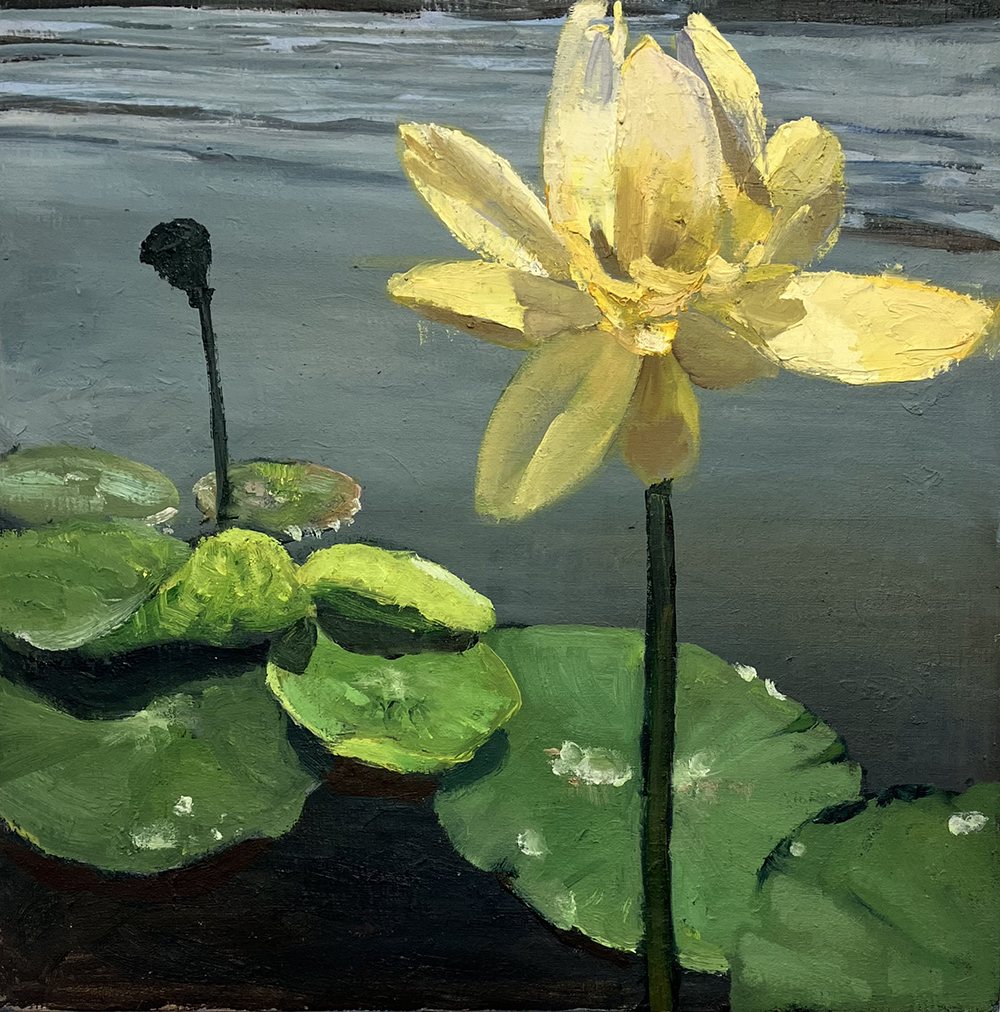
A painting from Emiquon by Basia Krol,
Emiquon National Wildlife Refuge this past year hosted artists who explored and responded to this natural resource in Lewiston. Emiquon’s history tracks from Native American habitation to trapping and fishing, land sales, levee building, and “reclaiming” the land for farming and animal husbandry.
The Nature Conservancy purchased the property in 2000 and halted the agricultural pumps in 2007, restoring the historic floodplain lakes. As the river floods during spring, backwater areas create shallow water habitats where sediment settles out and aquatic plants, algae, and fish nurseries thrive, thus nourishing the river system. Today, 2,600 acres of the Emiquon National Wildlife Refuge offer a hidden gem full of nearly 300 bird species and at least 30 native fish species.
LISA NELSON RAABE
Doug Reichert Powell, a Columbia College professor of writing and literature, said, “Exploring Mason and Fulton counties, it didn’t take me long to realize that the Emiquon Preserve is exactly the kind of place that fascinates me: simultaneously restored to an earlier state while also becoming something new and different, a landscape re-wilding while also serving as a sophisticated water treatment system.” Doug used his residency to write something site-specific, connecting different stories with spaces in a kind of story-map narrative that gives shape to this particular physical landmark.
Whitney Johnson-Lessard, an artist and art instructor, studied changing light and learned about mollusks and their relationship to fish. Whitney’s handmade paper includes brick and stone from Emiquon’s farming history and decaying structures. Buttons made from mollusk shells intrigued Whitney, and she is exploring their composition by restructuring calcium into new forms through chemical transformation.
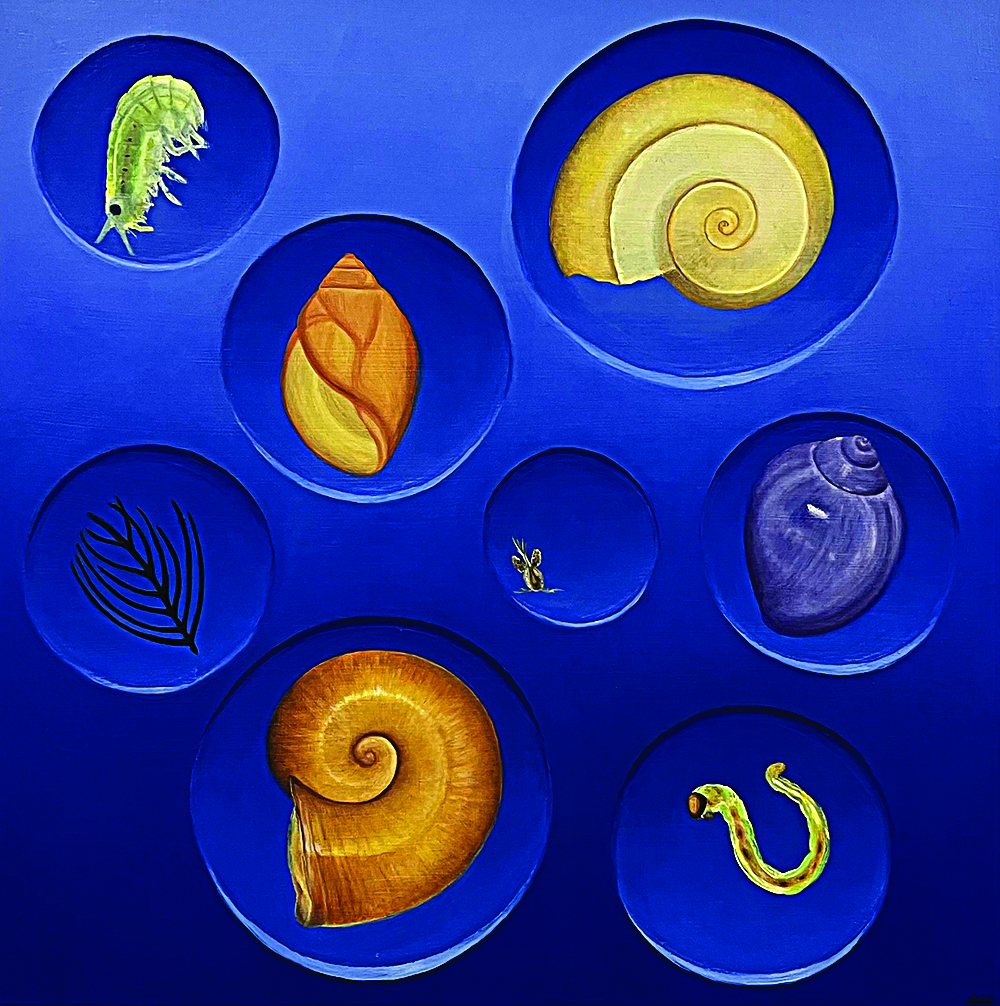
Adrienne Hagen, below, was inspired to create above painting after spending time at Emiquon National Wildlife Refuge
Adrienne Hagen, painter and Master Naturalist in training, writes, “Spending time at Emiquon in the winter has opened my senses to aspects of nature that I wouldn’t have noticed or appreciated at other times of the year. Patterns emerge, as the sinuous curves of a resting swan’s neck remind me of the winding gravel road I took to reach the water, and the meandering creek bed I passed along the way. Minuscule life forms swim beneath the ice, only revealing their vivid colors and patterns once examined under a microscope.” Working directly in the water, Adrienne recorded the tiniest of creatures and created miniature paintings of her petri dish worlds.
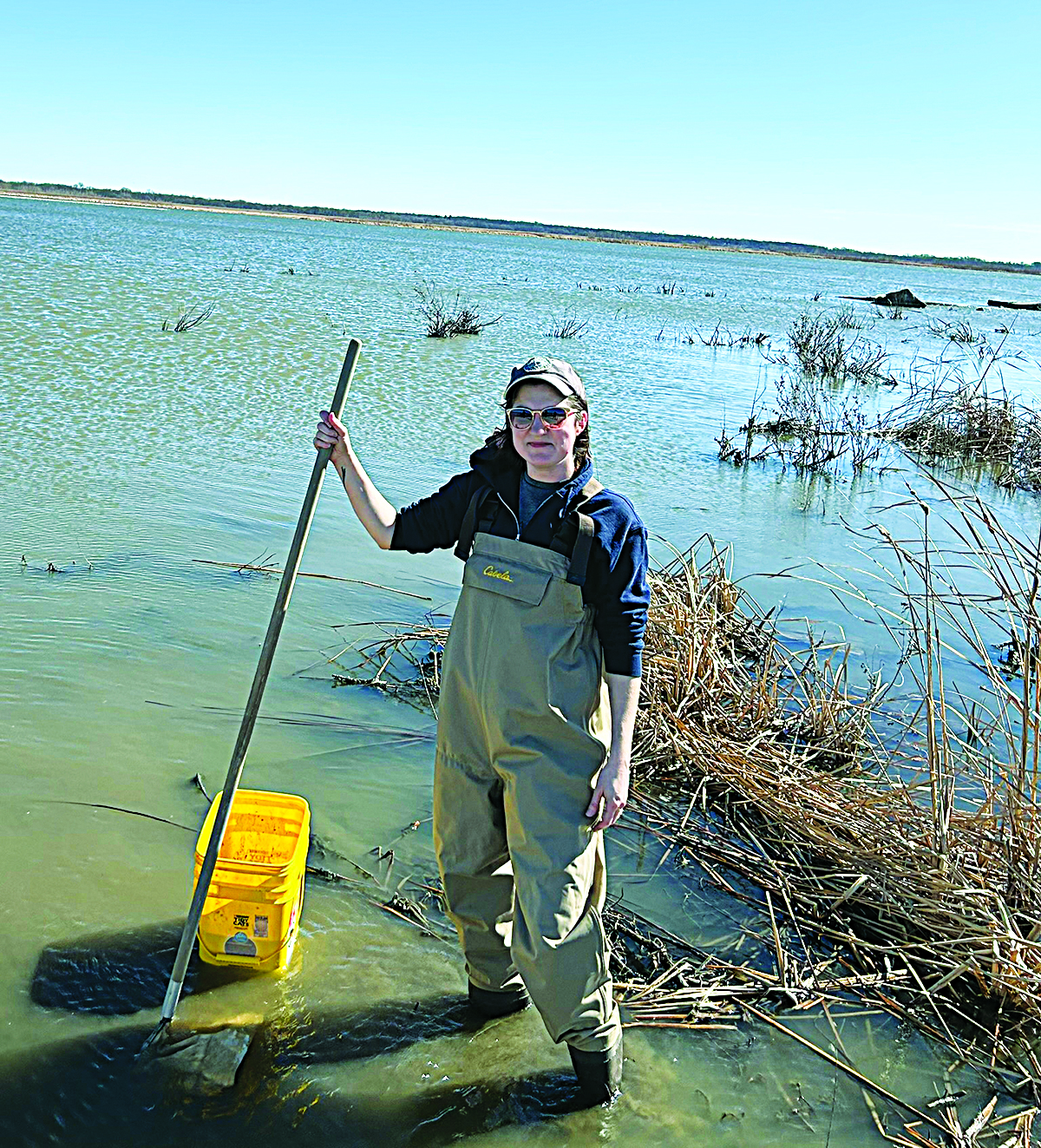
Adrienne Hagen doing time at Emiquon National Wildlife Refuge
Ann Marie Greenberg is a printmaker and sculptor who explores the endless versatility and perils of single-use plastic and it’s crossover into nature. She creates beauty in combination with natural elements and homemade bioplastic. Combining simple materials like cornstarch, glycerin and vinegar she makes translucent panels that encase and respond to natural elements.
Basia Krol, a Polish American currently living in Galesburg, painted in oil on site, recording light crossing inland waterways full of water lilies. Her vibrant paintings record the glow of dawn and dusk against the enduring spirit of the water lily emerging from murky depths into serene waters reflecting
a sky unbroken by commerce or architecture.
Valerie Walters is a full-time student at Northern Illinois University majoring in both Biology and Illustration with a focus on Medical and Biological Illustration. They returned to field study through photographing and painting to reveal life stages and the symbiotic relationship between plants and animals. Valerie also made paper from cattails to achieve gauze-like surfaces and painted native species on the paper.
Freedom Therapy Trio, Adam Larison (guitarist), Richard Gilman-Opalsky (percussion), and Brian Stark (Irish flute), improvised on the waterways and in the outbuildings at Therkildsen Field Station. Recorded musical sounds interlaced with bird song, toad croaking, wind, and water. Their musical style draws inspiration from responsive engagement with the environment, moving from minimalist sound paintings to swinging jazz and free improvisation.